

Protection of historic ruins - objectives for theory and practice
Article Sidebar
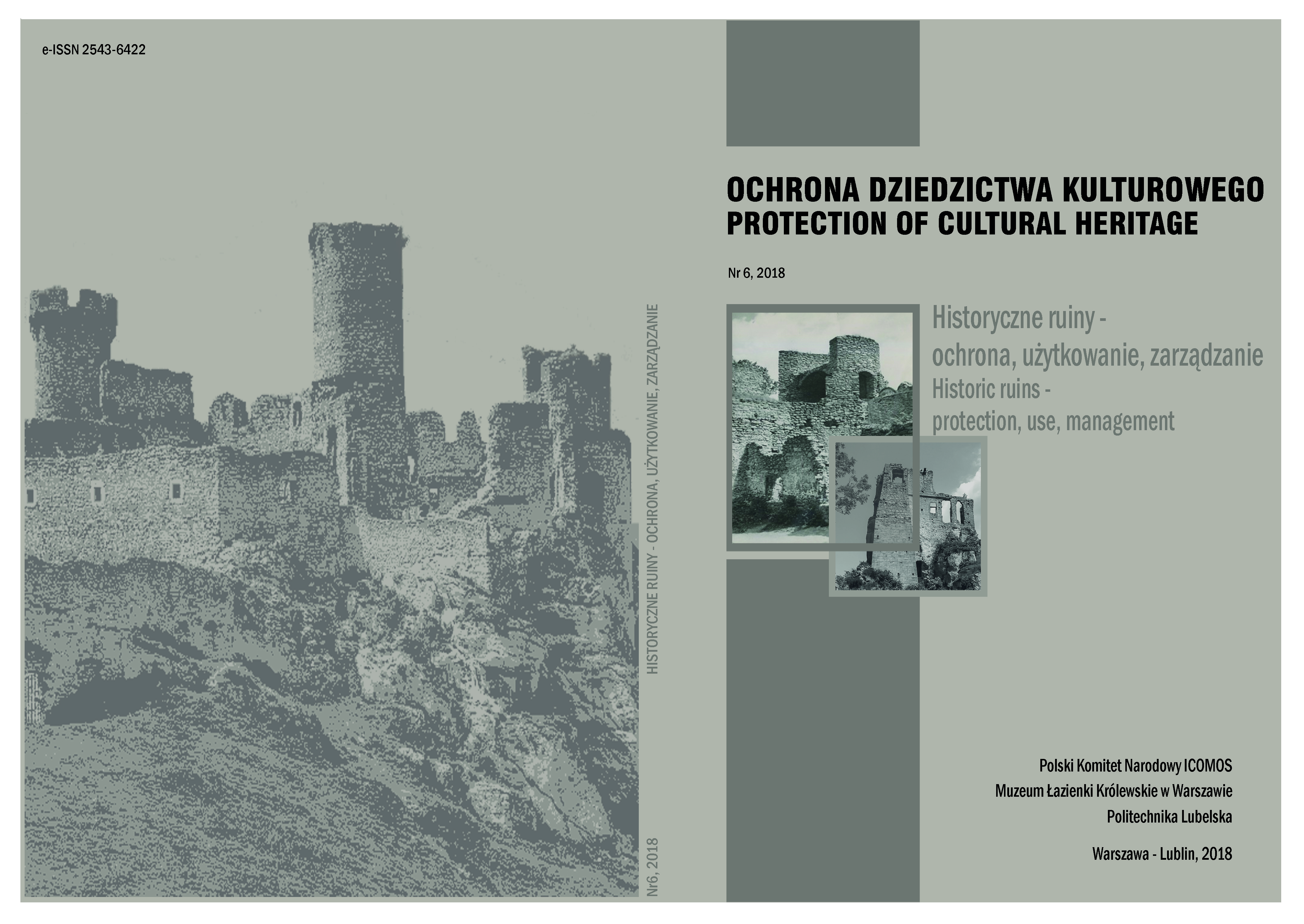
Open full text
Issue No. 6 (2018)
-
Protection of historical ruins - research and project problems on the example of the castle in Sochaczew
Maria Brykowska11-27
-
Protecting and displaying walls of the Człuchów Castle - former practices and current issues
Grzegorz Bukal29-42
-
Ambiguous role of post-industrial ruins in the cultural landscape of Poland
Jacek Dąbrowski, Bartosz M. Walczak43-52
-
The attractiveness of a permanent (durabel) ruin. Contemporary functioning of the historical ruins of castles in Małopolska
Paweł Dettloff53-71
-
Stocktaking methods of facilities in a state of ruin
Katarzyna Drobek, Bartosz Szostak, Wojciech Królikowski73-86
-
Charter on the Protection of Historic Ruins – theory and practice. Examples from Lesser Poland
Jan Janczykowski87-95
-
Urban design concepts of ruins in Gdańsk historical area
Agnieszka Kowalska97-104
-
Protection of historical ruins on the Polish-German border. A case of cultural heritage of the former Duchy of Pomeranian
Izabela Kozłowska, Agnieszka Lamprecht105-116
-
Protection and preservation of ruins - changes in the methods used in the Mazovian region
Jakub Lewicki117-134
-
'Foundation of Memory'. About the experience of space and remnants of the former concentration camp at the Kl Plaszow memorial site
Tomasz Owoc, Kamil Karski135-143
-
Some forts of Cracow Fortress become historical ruins. Purpose or necessity
Halina Rojkowska-Tasak145-151
-
Castle in Siewierz. Preservation and revalorisation of the historic ruins
Artur Rok153-162
-
Hammershus Castle - "Good Practices" and Managing Permanentl Ruin
Andrzej Siwek, Magdalena Trafas-Wołoszyn163-176
-
Selected issues of the investment process implementation in historic buildings on the example of the Castle of the Dukes of Mazovia in Ciechanów
Antoni Krzysztof Sobczak177-190
-
Protection of historic ruins - objectives for theory and practice
Bogusław Szmygin191-200
-
Biological corrosion and vegetation in the aspect of permanent ruin
Maciej Trochonowicz, Beata Klimek, Daniel Lisiecki201-212
-
Salt mill complex and warehouses of the former salt mine in Wapno. Considerations and premises for the protection of 20th-century post-industrial buildings as a permanent ruin
Miron Urbaniak213-223
Main Article Content
DOI
Authors
Abstract
The protection of historic ruins is a complex conservation task. This is mainly due to the ongoing destruction processes to which an incomplete object is exposed. At the same time, the character of the ruins means that most of the stakeholders support the reconstruction of historic ruins to the form of cubature objects. Therefore, the problem of protecting the ruins should be re-developed both from the theoretical as well as the practical side. From the theoretical point of view, it is important to distinguish between "historic ruin" and "contemporary ruin". From a practical point of view, it is crucial to organize protection programs that will balance the negative features of the ruins - not only will they stop the technical destruction processes but also will enable their contemporary management and use.
Keywords:
References
Dekret Rady Regencyjnej o opiece nad zabytkami sztuki i kultury, Dz.U. 1918 nr 16 poz. 36.
Gruszecki A., Konserwacja ruin w Anglii, „Ochrona Zabytków”, r. XI, 1958, nr 3-4.
Karta Ochrony Zabytkowych Ruin, PKN ICOMOS, 4 grudnia 2012 roku, http://www.icomos-poland.org/pl/dokumenty-doktrynalne.html.
Pamiętnik pierwszego zjazdu miłośników ojczystych zabytków w Krakowie w dniach 3 i 4 lipca 1911r., Kraków 1912.
Projekt “RUINS: Sustainable re-use, preservation and modern management of historical ruins in Central Europe - elaboration of integrated model and guidelines based on the synthesis of the best European experiences”.
Raport o stanie zachowania zabytków nieruchomych w Polsce. Zabytki wpisane do rejestru zabytków (księgi rejestru A i C), Narodowy Instytut Dziedzictwa, Warszawa 2017.
Riegla A., Georg Dehio i kult zabytków, P. Kosiewski (red.), Muzeum Pałac w Wilanowie, Warszawa 2012.
Szmygin B., Światowe Dziedzictwo Kultury UNESCO – charakterystyka, metodologia, zarządzanie, PKN ICOMOS, Politechnika Lubelska, Warszawa-Lublin, 2016.
Zabytek i historia. Wokół problemów konserwacji i ochrony zabytków w XIX wieku, P. Kosiewski, J. Krawczyk (red.), Muzeum Pałac w Wilanowie, Warszwa 2012.
Article Details
Bogusław Szmygin, Faculty of Civil Engineering and Architecture, Lublin University of Technology
prof. dr hab. inż., profesor Politechniki Lubelskiej; kierownik Katedry Konserwacji Zabytków (2004+); dziekan Wydziału Budownictwa i Architektury PL (2005-12; 2016+); prorektor Politechniki Lubelskiej (2012-2016); prezes Fundacji Rozwoju PL (2008-13).
Specjalizuje się w zagadnieniach ochrony i konserwacji zabytków architektury (m.in. teoria konserwatorska, Światowe Dziedzictwo UNESCO, rewitalizacja miasthistorycznych, ochrona ruin). Autor ponad 150 publikacji (m.in. monografii „Kształtowanie koncepcji zabytku i doktryny konserwatorskiej w Polsce w XX wieku”, „Vademecum Konserwatora Zabytków”, „Zasady projektowania i umieszczania nośników informacji wizualnej i reklam na obiektach i w obszarach zabytkowych”, „Światowe Dziedzictwo Kultury UNESCO – charakterystyka, metodologia,zarządzanie”, „Wartościowanie dziedzictwa w systemie SV – metoda i przykłady zastosowania”), redaktor naukowy ponad trzydziestu monografii, koordynator kilkunastu programów badawczych i edukacyjnych, autor kilkudziesięciu scenariuszy filmów edukacyjnych.
Prezes Polskiego Komitetu Narodowego ICOMOS (2008+2017), prezes Międzynarodowego Komitetu Teorii Konserwatorskiej (2018+), przewodniczący Komitetu ds. Światowego Dziedzictwa UNESCO w Polsce (2011-14), członek Komitetu Urbanistyki i Architektury PAN (2012+).



