

Korporacyjne praktyki zrównoważonego rozwoju w branżach zanieczyszczających środowisko: dowody z Indii, Chin i USA
##plugins.themes.bootstrap3.article.sidebar##
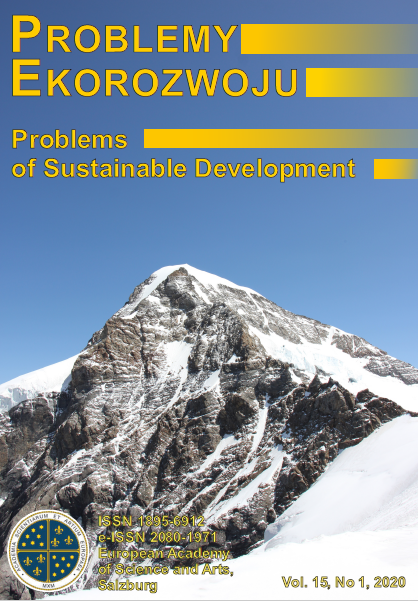
Numer Tom 15 Nr 1 (2020)
-
Ochrona środowiska w Chinach w dobie Nowej Ery z perspektywy wdrażania Eko-cywilizacji
Qingzhi Huan7-14
-
Funkcja i postrzeganie usług pełnionych przez ekosystemy miejskie w społeczeństwie
Fredrik Edlund15-23
-
Imigracja a społeczne aspekty zrównoważonego rozwoju. Przypadek Niemiec
Paweł Rydzewski25-31
-
Osiągnięcie trwałej przewagi konkurencyjnej za pomocą kapitału intelektualnego i podejścia korporacyjnego: pośrednicząca rola innowacji
Huan Xiao, Dengke Yu33-45
-
Etyka zrównoważonego rozwoju z perspektywy A. Badiou krytyki etyki współczesnej
Andrzej Papuziński47-52
-
Efektywność ekologiczna: fragmentacja etniczna a jakość zarządzania i zrównoważony rozwój
Viktor Koziuk, Yuryi Hayda, Oleksandr Dluhopolskyi, Serhii Kozlovskyi53-64
-
Teoretyczne podstawy zarządzania w aspekcie implementacji do sfery realnej procesu globalizacji i zrównoważonego rozwoju
Franciszek Piontek65-69
-
Czy pojawienie się migrantów zmienia postrzeganie przestrzeni publicznej przez obywateli? Przypadek naruszonej zrównoważoności, Belgrad, Serbia
Nataša Danilović Hristić, Nebojša Stefanović71-80
-
Konsumpcja i zrównoważony rozwój: aspekty etyczne
Maria Miczyńska-Kowalska81-88
-
Rola języka w zrównoważonym rozwoju: wielojęzyczność i umiejętność czytania i pisania w Indiach
Neha Toppo, Mojibur Rahman89-93
-
Teoria wartości w ekonomii rozwoju zrównoważonego
Małgorzata Pink95-102
-
Postawy kobiet wobec zrównoważenia środowiskowego poprzez ochronę przyrody
Jyoti Kumari, Ajit Kumar Behura, Sarita Kar103-107
-
Wpływ wybranych procesów biotechnologicznych na zrównoważony rozwój środowiska i życie człowieka
Aleksandra Badora, Magdalena Celińska109-117
-
Badania ankietowe jako sposób zrozumienia zachowania użytkowników w odniesieniu do zużycia energii w gospodarstwach domowych, przed podjęciem decyzji w celu promowania zrównoważonego rozwoju
G Venkatesh, Are Kjeang119-134
-
Zrównoważone środowisko jako główny czynnik urbanizacji w XIX i XX w.
Azizov Aghasalim135-148
-
Podejście zespolone: włączający, inteligentny i ekologiczny rozwój miast
Justyna Przywojska, Aldona Podgórniak-Krzykacz149-160
-
Korporacyjne praktyki zrównoważonego rozwoju w branżach zanieczyszczających środowisko: dowody z Indii, Chin i USA
Prem Sagar Mishra, Ajay Kumar, Niladri Das161-168
-
Możliwość wykorzystania rzepaku ozimego (Brassica napus L. var. Napus) do celów energetycznych
Jakub Siemek, Jan Macuda, Łukasz Łukańko, Jakub Nowak, Tadeusz Zając167-177
-
Nowe podejście do systemowych zmian na lądzie na pograniczu: przypadek pogranicza Chin i innych krajów azjatyckich
Xiaobo Hua, Yasuyuki Kono179-187
-
NER300: sukces czy porażka publicznego wsparcia technologii niskoemisyjnych?
Grażyna Borys189-196
-
Identyfikacja regionu Ługańska i regionalnego prawa zgodnie z wymaganiami zrównoważonego rozwoju w warunkach Operacji Wspólnych Sił
Inna Zablodska, Svitlana Hrechana, Daria Zablodska197-210
-
Cele Zrównoważonego Rozwoju w Regionie Arabskim – Studium Przypadku Zjednoczonych Emiratów Arabskich
Adam Krzymowski211-220
-
Teatr na rzecz zrównoważonego rozwoju: Jana Sanskriti partycypacyjna ideologia i praktyka
Shubhra Ghoshal, Nirban Manna221-227
-
Ryzyko i niepewność w zakresie zrównoważonego rozwoju: kwestia polityki wobec zmian klimatu w Stanach Zjednoczonych
Olena Ovchynnikova229-235
Archiwum
-
Tom 17 Nr 2
2022-07-04 26
-
Tom 17 Nr 1
2022-01-03 28
-
Tom 16 Nr 2
2021-07-01 26
-
Tom 16 Nr 1
2021-01-04 24
-
Tom 15 Nr 2
2020-07-01 24
-
Tom 15 Nr 1
2020-01-02 24
-
Tom 14 Nr 2
2019-07-01 20
-
Tom 14 Nr 1
2019-01-02 20
-
Tom 13 Nr 2
2023-10-15 22
-
Tom 13 Nr 1
2018-01-02 23
##plugins.themes.bootstrap3.article.main##
Authors
Abstrakt
W ostatnich latach wyraźnie widać w tradycyjnych praktykach rachunkowych przechylenie świata korporacyjnego w kierunku sprawozdawczości niefinansowej. Raportowania zrównoważonego rozwoju są ważnym narzędziem dostarczającym informacji o środowiskowych i społecznych wynikach działalności przedsiębiorstw różnym interesariuszom. Z perspektywy finansowej, dla każdej firmy, zawsze istnieje możliwość zgłoszenia większej ilości informacji, które faworyzują ich interesy lub ukrywają te, które są niekorzystne. W artykule oceniono roczne raporty dotyczące zrównoważonego rozwoju 380 indyjskich, 400 chińskich i 400 amerykańskich firm z pięciu wysoce zanieczyszczających środowisko branż na podstawie wytycznych GRI (Globalnych Inicjatyw Sprawozdawczych). Dokonane ustalenia są zgodne z teorią legalności. Otrzymane wyniki pokazują, że rentowność i struktura kapitałowa firm nie wpływają znacząco na praktyki raportowania zrównoważonego rozwoju. Ponadto większe firmy mają tendencję do ujawniania większej ilości informacji w swoich rocznych raportach i raportach dotyczących zrównoważonego rozwoju niż mniejsze firmy.
Słowa kluczowe:
Bibliografia
ADAMS C., NARAYANAN V., 2007, The standardization of sustainability reporting, in: Sustainability Accounting and Accountability, ed. Unerman J., Bebbington J., O’Dwyer B., Routledge, London and New York, p. 70-85.
AKISIK O., GAL G., 2014, Financial performance and reviews of corporate social responsibility reports, in: Journal of Management Control, 25(3-4), p. 259-288.
AUPPERLE G., CARROL A., HATFIELD J., 1985, An empirical examination of the relationship between corporate social responsibility and profitability, in: Academy of Management Journal, 22, p. 501-515.
BANSAL P., HOFFMAN A. J., 2012, The Oxford handbook of business and the natural environment, Oxford University Press, Oxford.
BEBBINGTON J., LARRINAGA C., 2014, Accounting and sustainable development: An exploration, in: Accounting, Organizations and Society, 39(6), p. 395-413.
BEBBINGTON J., LARRINAGA C., MONEVA J. M., 2008, Corporate social reporting and reputation risk management, in: Accounting, Auditing and Accountability Journal, 21(3), p. 337-361.
BEBBINGTON J., UNERMAN J., O’DWYER, B., 2014, Sustainability accounting and accountability, Routledge, Abingdon.
BEWLEY K., LI Y., 2000, Disclosure of environmental information by Canadian manufacturing companies: a voluntary disclosure perspective, in: Advances in Environmental Accounting & Management, 1, p. 201-226.
BRAMMERS., PAVELINS., 2008, Factorsinfluencing the quality of corporate environmental disclosure, in: Business Strategy and the Environment, 17, p. 120-136.
BRANCO M., RODRIGUES L., 2008, Factors influencing social responsibility disclosure by Portuguese companies, in: Journal of Business Ethics, 83, p. 68-701
BURRITT R. J., TINGEY-HOLIOYAK J., 2012, Forging cleaner production: the importance of academic-practitioner links for successful sustainability embedded carbon accounting, in: Journal of Cleaner Production, 36 (1) , p. 39-47.
CAMPBELL J. L., 2007, Why would corporations behave in socially responsible ways? An institutional theory of corporate social responsibility, in: Academy of Management Review, 32(3), p. 946-967.
CHEN J. C., ROBERTS R. W., 2010, Towards a more integrated understanding of the organizationsociety relationship: Implications for social and environmental accounting research, in: Journal of Business Ethics, 97(4), p. 651-665.
CHEN S., BOUVAIN P., 2009, Is corporate responsibility converging? A comparison of corporate responsibility reporting in the USA, UK, Australia, and
Germany, in: Journal of Business Ethics, 87, p. 299-317.
CLARKSON P. M., LI Y., RICHARDSON G. D., VASVARI F. P., 2008, Revisiting the relation between environmental performance and environmental disclosure: An empirical analysis, in: Accounting, Organizations and Society, 33(5), p. 303-327.
COLI M., NISSI E., RAPPOSELLI A., 2011, Monitoring environmental efficiency: an application to Italian provinces, in: Environmental Modelling & Software, 26(1), p. 38-43.
DEEGAN C., BLOMQUIST C., 2006, Stakeholder influence on corporate reporting: An exploration of the interaction between WWF-Australia and the Australian minerals industry, in: Accounting, Organizations and Society, 31(4-5), p. 343-372.
DYLLICK T, HOCKERTS K., 2002, Beyond the Business Case for Corporate Sustainability, in: Business Strategy and the Environment, 11, p. 130-141.
ECCLES R., IOANNOU I., SERAFEIM G., 2012, The impact of corporate sustainability on organizational processes and performance, in: Working paper, Harvard Business School, Harvard University, Boston.
ELKINGTON J., 2002, The Triple Bottom Line of the 21st Century, Oxford Press, Oxford.
FIELDS T.D., LYS T.Z., VINCENT L, 2001, Empirical research on accounting choice, in: Journal of Accounting and Economics, 31, p. 255-307.
FRIEDMAN, M. (2007). The social responsibility of business is to increase its profits, in: Corporate social responsibility. Volume 1: theories and concepts of corporate social responsibility, eds. Crane A, Matten D, Sage Publications, London, p. 69-74.
FROOMAN J., 1999, Stakeholder influence strategies, in: The Academy of Management Review, 24(2), p. 191-205.
GAMERSCHLAG R., MÖLLER K., VERBEETEN F., 2011, Determinants of voluntary CSR disclosure: empirical evidence from Germany, in: Review of Managerial Science, 5 (23), p. 233-262.
GAVANA G., GOTTARDO P., MOISELLO A.M., 2017, Sustainability Reporting in Family Firms: A Panel Data Analysis, in: Sustainability, 9, p. 38.
GODHA A., JAIN P., 2015, Sustainability reporting trend in Indian companies as per GRI framework: a comparative study, in: South Asian Journal of Business and Management Cases, 4(1), p. 62-73.
GOMEZ-MEJIA L.R., HAYNES K.T., NUNEZNICKEL M., JACOBSON K.J.L., MOYANOFUENTES J., 2007, Socioemotional wealth and business risks in family-controlled firms: Evidence from Spanish olive oil mills, in: Administrative Science Quarterly, 52, p. 106-137.
GOND J.P., GRUBNIC S., HERZING C., MOON J., 2012, Configuring management control systems: theorizing the integration of strategy and sustainability, in: Management Accounting Research, 23(3), p. 205-223.
GRAY R., 2010, Is accounting for sustainability actually accounting for sustainability and how would we know? An exploration of narratives of organizations and the planet, in: Accounting, Organizations and Society, 35(1), p. 47-62.
GRAY R., KOUHY R., LAVERS S., 1995, Corporate social and environmental reporting: A review of the literature and a longitudinal study of UK disclosure, in: Accounting, Auditing & Accountability Journal, 8(2), p. 47-71.
GRI, 2013, https://www.globalreporting.org/information/news-and-press-center/Pages/GRI-amongthe-most-popular-CSR-instruments.aspx (13.09.2017).
GRI, 2009, https://www.globalreporting.org/resourcelibrary/GRI-Sustainability-Report-2009-2010.pdf (30.09.2017).
HANIFFA R.M., COOKE T.E., 2005, The impact of culture and governance on corporate social reporting, in: Journal of Accounting and Public Policy, 24, p.391-430.
HENRI J., BOIRAL O., ROY M.J., 2013, The tracking of environmental costs: motivations and impacts, in: European Accounting Review, https://doi.org/10.1080/09638180.2013.837400.
HUSTED B.W., SALZAR J., 2006, Taking Friedman seriously: maximizing profits and social performance, in: Journal of Management Studies, 43(1), p. 75-91.
IPPC (INTERGOVERNMENTAL PANEL ON CLIMATE CHANGE), 2014, IPCC fifth assessment synthesis report, https://www.ipcc.ch, (13.09.2017).
ISLAM M. A., DEEGAN C., 2010, Media pressures and corporate disclosure of social responsibility performance: a case study of two Global clothing and sports retail companies, in: Accounting and Business Research, 40(2), p. 131-148.
IYER V., LULSEGED A., 2013, Does family status impact US firms’ sustainability reporting?, in: Sustainability Accounting, Management and Policy Journal, 4, p. 163-189.
JACKSON T., 2009, Prosperity without growth, Earthscan, London.
KALM M., GOMEZ-MEJIA L.R., 2016, Socioemotional wealth preservation in family firms, in: Revista de Administração, 51, p. 409-411.
KAUR A., SHARMA P.C., 2017, Environment Development Sustainability, https://doi.org/10.1007/s10668-017-9961-5.
KOLK A., 2005, Environmental reporting by multinationals from the Triad: convergence or divergence, in: Management International Review, 45(1), p. 145-166.
KUMAR A., DAS N., 2018, Sustainability Reporting Practices in Emerging Economies: A Cross-Country Study of BRICS Nations, in: Problemy Ekorozwoju/Problems of Sustainable Development, 13(2), p. 17-25.
KOTHARI A., 2013, Development and ecological sustainability in India: Possibilities for Post-2015 framework, in: Oxfam India working paper series, http://www.environmentportal.in/files/file/development%20and%20ecological%20sustainability%20in%20india.pdf (15.05.2016).
KUOSMANEN T., KUOSMANEN N., 2009, How not to measure sustainable value (and how one might), in: Ecological Economics, 69(2), p. 235-243.
LAINE M., 2010, Towards sustaining status quo: Business talk of sustainability in Finnish corporate disclosures 1987-2005, in: European Accounting Review, 19(2), p. 247-274.
LINDBLOM C. K., 1993, The implications of organizational legitimacy for corporate social performance and disclosure, in: The critical perspectives on accounting conference, New York.
LOH L., THOMAS T., WANG Y., 2017, Sustainability Reporting and Firm Value: Evidence from Singapore-Listed Companies, in: Sustainability, https://doi.org/10.3390/su9112112.
MALSCH B., 2013, Politicizing the expertise of the accounting industry in the realm of corporate social responsibility, in: Accounting, Organizations and Society, 38(2), p. 149-168.
MANI V., GUNASEKARAN A., PAPADOPOULOS T., HAZEN B., DUBEY R., 2016, Supply chain social sustainability for developing nations: Evidence from India, in: Resources Conservation and Recycling, 111, p. 42-52.
MCWILLIAMS A., SIEGEL D., 2001, Corporate social responsibility: a theory of the firm perspective, in: The Academy of Management Review, 26(1), p. 117-127.
MEBRATU D., 1998, Sustainability and Sustainable Development: Historical and Conceptual Review, in: Environmental Impact Assessment Review, 18, p. 493-520.
MILNE M. J., 2002, Positive accounting theory, political costs and social disclosure analyses: a critical look, in: Critical Perspect Account, 13, p. 369-395.
MILNE M. J., GRAY R., 2013, W(h)ither ecology? The triple bottom line, the Global Reporting Initiative and corporate sustainability reporting, in: Journal of Business Ethics, 118(1), p. 13-29.
MILNE M., TREGIDGA H., WALTON S., 2009, Words not actions! The ideological role of sustainable development reporting, in: Accounting, Auditing & Accountability Journal, 22(8), p. 1211-1257.
MUNDA G., SAISANA M., 2011, Methodological considerations on regional sustainability assessment based on multicriteria and sensitivity analysis, in: Regional Studies, 45(2), p. 261-276.
OWEN D. L., 2008, Chronicles of wasted time? A personal reflection on the current state of, and future prospects for, social and environmental accounting research, in: Accounting, Auditing & Accountability Journal, 21(2), p: 240-267.
PARKER L. D., 2005, Social and environmental accountability research: A view from the commentary box, in: Accounting, Auditing & Accountability Journal, 18(6), p. 842-860.
PARRIS T. M., KATES R. W., 2003, Characterizing and measuring sustainable development, in: Annual Review of environment and resources, 28(1), p. 559-586.
PERES-NETO P. R., LEGENDRE P., DRAY S., BORCARD, D., 2006, Variation partitioning of species data matrices: estimation and comparison of fractions, in: Ecology, 87(10), p. 2614-2625.
ROCKSTRÖM J., STEFFEN W., NOONE K., PERSSON Å., CHAPIN III F.S., LAMBIN E.F., LENTON T.M., SCHEFFER M., FOLKE C., SCHELLNHUBER H.J., NYKVIST B., 2009, A safe
operating space for humanity, in: Nature, 461(7263), p. 472.
RODRIGUE M., MAGNAN M., & CHO C. H., 2013, Is environmental governance substantive or symbolic? An empirical examination, in: Journal of Business Ethics, 114(1), p. 107-129.
SODHI M.S., 2015, Conceptualizing social responsibility in operations via stakeholder resource‐based view, in: Production and Operations Management, 24(9), p. 1375-1389.
SPAR D., LAMURE L., 2003, The power of activism: Assessing the impact of NGOs on global business, in: California Management Review, 45(3), p. 78-101.
SPENCE C., 2009, Social accounting’s emancipatory potential, in: Critical Perspectives on Accounting, 20(2), p. 205-227.
SUCHMAN M. C., 1995, Managing legitimacy: Strategic and institutional approaches, in: Academy of Management Review, 20(3), p. 571-610.
TANG C. S., ZHOU S., 2012, Research advances in environmentally and socially sustainable operations, in: European Journal of Operational Research, 223(3), p. 585-594.
TREGIDGA H., MILNE M., KEARINS K., 2014, (Re)presenting ‘sustainable organizations’, in: Accounting, Organizations and Society, 39(6), p. 477-494.
TYTECA D.,1998, Sustainability indicators at the firm level, in: Journal of Industrial Ecology, 2(4), p. 61-77.
WATTS R.L., ZIMMERMANN J.L., 1990, Positive accounting theory: a ten year perspective, in: Account Review, 65(1), p. 131-156.
WINFIELD M., GIBSON R. B., MARKVART T., GAUDREAU K., TAYLOR J., 2010, Implications of sustainability assessment for electricity system design: The case of the Ontario Power Authority‘s integrated power system plan, in: Energy Policy, 38(8), p. 4115-4126.
ZIENTARA P., 2015 Socioemotional wealth and corporate social responsibility: A critical analysis, in: Journal of Business Ethics, 144(1), p. 185-199.
ZHOU H., YANG Y., CHEN Y., ZHU J., 2017, Data Envelopment Analysis Application in Sustainability: The Origins, Development and Future Directions, in: European Journal of Operational Research, 264(1), p. 1-16.
##plugins.themes.bootstrap3.article.details##
Abstract views: 386
Downloads: 150
Licencja

Utwór dostępny jest na licencji Creative Commons Uznanie autorstwa – Na tych samych warunkach 4.0 Miedzynarodowe.



