

Torreón na Machu Picchu: obserwatorium astronomiczne?
##plugins.themes.bootstrap3.article.sidebar##
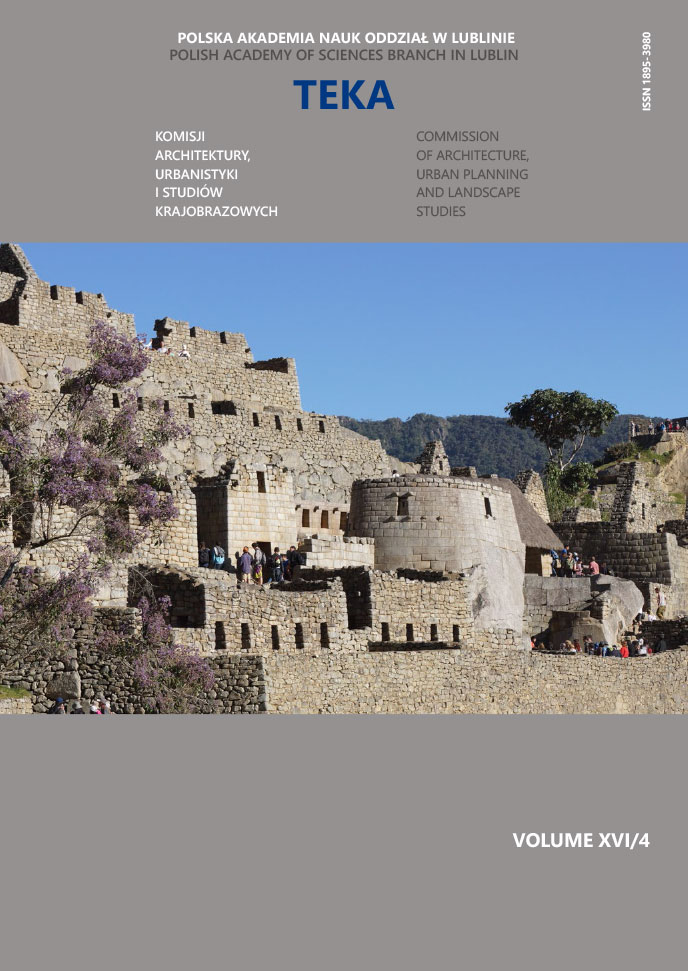
Numer Tom 16 Nr 4 (2020)
-
Torreón na Machu Picchu: obserwatorium astronomiczne?
Jacek Kościuk, Mariusz Ziółkowski7-31
-
Wykorzystanie skaningu laserowego przy inwentaryzacji poterny Twierdzy Kłodzko
Piotr Gleń, Karol Krupa32-39
-
„Topole i Cyprysy” – czyli rzecz o fenomenie popularności Populus Italica w Królestwie Polskim w XIX wieku
Kamila Lucyna Boguszewska40-51
-
Wnętrza w polskim filmie fabularnym lat 60-tych jako źródło wiedzy i punkt odniesienia dla współczesnych projektów architektonicznych
Agata Gawlak, Magda Matuszewska52-58
-
Dwa kościoły, dwóch architektów, jedna sylweta – „styl narodowy” a zapożyczanie form w architekturze sakralnej II RP
Anna Tejszerska59-69
-
Rola historycznej zieleni w kształtowaniu krajobrazu śródmieścia Lublina
Natalia Przesmycka, Kamila Boguszewska70-85
-
Wieś idealna – układ przestrzenny i zabudowa miejscowości Paproć Duża
Małgorzata Dolistowska86-99
-
Przesłanie szesnastego Międzynarodowego Biennale Architektury w Wenecji w 2018 roku na tle przesłania innych edycji
Hubert Trammer100-105
-
Przekształcenia przestrzeni miejskiej, miejsce i nie-miejsce
Dariusz Gaweł106-113
-
Stylistyka wnętrz historycznych budynków położonych w wybranych miejscowościach uzdrowiskowych na Huculszczyźnie – zarys problematyki
Jacek Czubiński114-127
-
Projektowanie partycypacyjne obiektów służby zdrowia z wykorzystaniem wirtualnej rzeczywistości
Piotr Springer128-136
Archiwum
-
Tom 18 Nr 4
2022-12-30 5
-
Tom 18 Nr 3
2022-12-27 5
-
Tom 18 Nr 2
2022-12-27 5
-
Tom 18 Nr 1
2022-12-27 4
-
Tom 17 Nr 4
2021-12-30 11
-
Tom 17 Nr 3
2021-12-30 9
-
Tom 17 Nr 2
2021-12-30 8
-
Tom 17 Nr 1
2021-12-30 8
-
Tom 16 Nr 4
2020-12-30 11
-
Tom 16 Nr 3
2020-09-30 10
-
Tom 16 Nr 2
2020-06-30 11
-
Tom 16 Nr 1
2020-03-31 10
-
Tom 15 Nr 4
2019-12-30 6
-
Tom 15 Nr 3
2019-10-31 9
-
Tom 15 Nr 2
2019-06-28 12
-
Tom 15 Nr 1
2019-03-29 13
-
Tom 14 Nr 3
2018-10-28 14
-
Tom 14 Nr 2
2018-06-29 14
-
Tom 14 Nr 1
2018-03-30 13
##plugins.themes.bootstrap3.article.main##
Authors
Abstrakt
Torreón jest jednym z najbardziej emblematycznych budynków Machu Picchu. Poczynając już od 1929 roku, wielu badaczy starało się zweryfikowac tezę iż Torreón funkcjonwał jako obserwatorium atronomiczne. Opierając się na danych z laserowego skanowania 3D i modelowaniu cyfrowym, autorzy prezentowanego tu tekstu szczegółowo analizują wszystkie te hipotezy . W konkluzji stwierdzają że wprawdzie nie ulega wątpliwości iż budowniczowie Torreónu podporządkowali jego plan pewnym solarnym orientacjom, celem jednak nie było wzniesienie obserwatorium astronomicznego, jak to ewidentnie miało miejsce w przypadku Intimachay i Inkaraqay.
Słowa kluczowe:
Bibliografia
Aveni Anthony F., On Seeing the light: A Reply to Here Comes the Sun by Dearborn and Schreiber, Archaeoastronomy: Journal of the Center for Archaeoastronomy, 1988, Vol. 10, pp. 22−24.
Astete Victoria Fernando, Mariusz Ziółkowski and Jacek Kościuk, On Inca astronomical instruments: the observatory at Inkaraqay – El Mirador (National Archaeological Park of Machu Picchu, Peru), Estudios Latinoamericanos, Sociedad polaca de Estudios Latinoamericanos, Warszawa 2016/17, vol. 36/37, pp. 9−25.
Bingham Hiram, The Yale Peruvian Expedition: Preliminary Report, The Geographical Journal , Mar., 1912, Vol. 39, No. 3 (Mar., 1912), pp. 235−241.
Bingham Hiram, Machu Picchu, a citadel of the Incas; report of the explorations and excavations made in 1911, 1912 and 1915 under the auspices of Yale University and the National Geographic Society. London 1930, H. Milford, Oxford University Press, Memoirs of the National Geographic Society, no. 1.
Canuti Paolo et all, Monitoring, Geomorphological Evolution and Slope Stability of Inca Citadel of Machu Picchu: Results from Italian INTERFRASI project; in: K. Sassa, P. Canuti (eds.), Landslides – Disaster Risk Reduction, Springer-Verlag Berlin – Heidelberg 2009.
Czerner Rafał and Martusewicz Jacek, The results of research conducted by the polish archaeological and conservation mission sent by the Ministry of Culture and National Heritage and Ministry of Foreign Affairs (Republic of Poland) in the area of the archaeological park of Machu Picchu (Peru), Estudios Latinoamericanos, Warszawa 2012, vol. 32, pp. 131−191.
Dearborn David S.P. and White Raymond E., Archaeoastronomy at Machu Picchu; in: Aveni, A., and Urton, G. (eds.), Ethnoastronomy and Archaeoastronomy in the American Tropics, Vol. 385, Annals of the New York Academy of Sciences, New York 1982, pp. 249−259.
Dearborn David S.P. and White Raymond E., The Torreon at Machu Picchu as a Solar Observatory, Archaeoastronomy n° 5, supplement to the Journal for the History of Astronomy, 1983, vol. 14, pp. 37−49.
Dearborn David S.P. and Schreiber Katherina, Here Comes the Sun: The Cuzco-Machu Picchu Connection, Archaeoastronomy. Journal of the Center for Archaeoastronomy, 1986, 9, pp. 15−37.
Hyslop John, Inka Settlement Planning. University of Texas Press. Kindle Edition: Chapter 8: Orientation and Alignment: Astronomical Concerns; Subchapter: Windows, Light, and Shadow Casting at Machu Picchu, 2014.
Kendall D.G., Hunting quanta, Philosophical Transactions of the Royal Society of London. Series A, Mathematical and Physical Science”, Vol. 276, No. 1257, 1974, pp. 231−266.
Klokočník Jaroslav, Kostelecký Jan, Hanzalová Karolína, Astronomical-Solar Orientation of Inca Features in Yurac Rumi, Machu Picchu and Ollantaytambo, Peru. Presentation at SEAC 2012 Conference, Lubliana 24−29 Septembre 2012. Internet source: http://www.asu.cas.cz/~jklokocn/PPT_Ljubljana_YuracRumi_etc_Klokocnik_etal_2012.ppt (accesed 12.11.2020).
Kubicka A., Zastosowanie metody cosine quantogram do analizy metrologicznej kompleksu Machu Picchu/Application of a cosine quantogram method in the metrological analysis of the Machu Picchu settlement, Doctoral thesis submitted to the Faculty of Architecture, Wrocław University of Science and Technology, Wrocław 2019.
Malville John McKim, Machu Picchu; in: C.L.N. Ruggles (ed.), Handbook of Archaeoastronomy and Ethnoastronomy, Springer Science+Business Media New York 2015, pp. 879−891.
Müller Rolf, Die Intiwatana (Sonnenwarten) im alten Peru mit 8 Abbildungen und 6 Figuren, Baessler-Archiv. Beitäge zur Völkerkunde, Band XIII (Alfred Maass, ed.), Berlin 1929, 178−187 (internet source: https://www.digi-hub.de/viewer/fullscreen/1500547264653/492/.
Müller Rolf, Sonne, Mond und Sterne über dem Reich der Inka. Springer-Verlag Berlin – Heidelberg 1972.
Pakkanen Jari, Deriving ancient foot units from building dimensions: A statistical approach employing cosine quantogram analysis; in: G. Burenhult, J. Arvidsson (eds.), Archaeological Informatics: Pushing the Envelope, Proceedings of the 29th CAA conference 2001, pp. 501−506.
Rostworowski de Diez Canseco, María, Mediciones y Cómputos en el Antiguo Perú, Cuadernos Prehispánicos No 6, Seminario Americanista, Universidad de Valladolid, Valladolid 1978.
Salazar Garces Erwin, Astronomia Inka. Arqueoastronomía & etnoastronomía. Museo Andres del Castillo, Lima 2014.
s.n. (sine nomine), Machu Picchu. Catálogo de la colección, Lima 2011, p. 171, (Photo: Herman Trucker).
White Raymond, Field Expedition to Machu Picchu. Archaeoastronomy; Journal of the Center for Archaeoastronomy, 1981, vol. IV, number 2.
Ziółkowski Mariusz, Kościuk Jacek, Astronomical observations in the Inca Temple of Coricancha (Cusco)? A critical review of the hypothesis. Teka Komisji Architektury, Urbanistyki i Studiów Krajobrazowych Tom XIV/1, Lublin 2018, pp. 7−33.
Ziółkowski Mariusz, Kościuk Jacek, Astete Victoria Fernando, Astronomical observations at Intimachay (Machu Picchu): a new approach to an old problem, Anthropological Notebooks, 2013, Vol. 19, 391−404.
Ziółkowski Mariusz, Bastante Abuhadba José, Hogg Alan, Sieczkowska Dominika, Rakowski Andrzej, Pawlyta Jacek, Manning Sturt, When did the Incas build Machu Picchu and its satellite sites? New approches based on radiocarbon dating Radiocarbon, First View, Cambridge University Press, 2020, pp. 1–15. Online edition: https://www.cambridge.org/core/journals/radiocarbon/article/when-did-the-incas-build-machu-picchu-and-its-satellite-sites-new-approches-based-on-radiocarbon-dating/10254F52B68EAC0960DB85D91BB66593.
##plugins.themes.bootstrap3.article.details##
Abstract views: 926
Downloads: 646
Licencja

Utwór dostępny jest na licencji Creative Commons Uznanie autorstwa – Na tych samych warunkach 4.0 Miedzynarodowe.
