

Classroom training strategies to strengthen the hotbed of research in architecture
##plugins.themes.bootstrap3.article.sidebar##
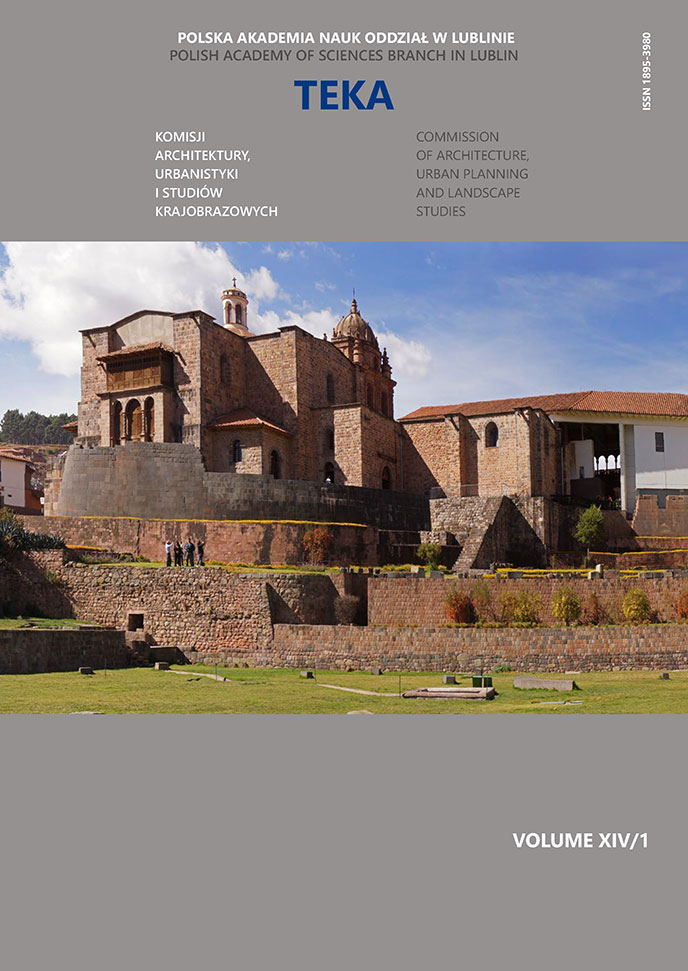
Numer Tom 14 Nr 1 (2018)
-
Astronomical observations in the Inca Temple of Coricancha (Cusco)? A critical review of the hypothesis
Mariusz Ziółkowski, Jacek Kościuk7-33
-
Lighting policy as an integral part of sustainable urban planning
Agata Łopuszyńska, Magdalena Belof34-43
-
Optical properties of opaque and light-transmitting photovoltaic systems in architecture and their influence on architectural form
Marcin Brzezicki, Magdalena Muszyńska-Łanowy44-54
-
Środowisko zbudowane mieszkalnych budynków wysokich w Polsce
Dariusz Gawel55-62
-
Features of housing sanation in the historical architectural environment
Kateryna Danko, Kashchenko Tetyana63-70
-
Hipotetyczna rekonstrukcja faz rozwojowych systemu obronnego śródmieścia miasta Rohatyna w XV−XVII w.
Mykola Bevz71-88
-
Modernizacja przestrzeni publicznych w problematycznych dzielnicach mieszkaniowych na przykładzie wybranych projektów i realizacji w dzielnicy Bronowice w Lublinie
Kamila Boguszewska, Natalia Przesmycka89-97
-
Projekt rewitalizacji terenu przy pałacu Potockich w Lublinie
Patryk Krupiński, Krystyna Pudelska98-106
-
Classroom training strategies to strengthen the hotbed of research in architecture
Rolando Arturo Cubillos González107-115
-
Effect of accessibility in housing complexes on shaping of beauty in the urban environment. Selected examples from Cracow
Karolina Dudzic-Gyurkovich116-125
-
Architecture in transition: the case study of the dormition catedral in Volodymyr Volynskyi
Petro Rychkov126-135
-
Najwcześniejsze publiczne założenia zieleni związane z Jelenią Górą, cz. 1.
Marzanna Jagiełło, Wojciech Brzezowski136-144
-
Przegląd oraz klasyfikacja zespołów mieszkaniowych przeznaczonych dla osób starszych i niepełnosprawnych występujących w krajach wysokorozwiniętych w kontekście deficytu podobnych rozwiązań w Polsce
Monika Magdziak145-155
Archiwum
-
Tom 16 Nr 4
2020-12-30 11
-
Tom 16 Nr 3
2020-09-30 10
-
Tom 16 Nr 2
2020-06-30 11
-
Tom 16 Nr 1
2020-03-31 10
-
Tom 15 Nr 4
2019-12-30 6
-
Tom 15 Nr 3
2019-10-31 9
-
Tom 15 Nr 2
2019-06-28 12
-
Tom 15 Nr 1
2019-03-29 13
-
Tom 14 Nr 3
2018-10-28 14
-
Tom 14 Nr 2
2018-06-29 14
-
Tom 14 Nr 1
2018-03-30 13
-
Tom 13 Nr 4
2017-12-29 8
-
Tom 13 Nr 3
2017-09-29 9
-
Tom 13 Nr 2
2017-06-30 10
-
Tom 13 Nr 1
2017-03-31 10
-
Tom 12 Nr 4
2016-12-30 12
-
Tom 12 Nr 3
2016-09-30 10
-
Tom 12 Nr 2
2016-06-30 9
-
Tom 12 Nr 1
2016-03-31 8
##plugins.themes.bootstrap3.article.main##
Authors
Abstrakt
The Architecture program at the Catholic University of Colombia needs to strengthen the research processes within its classrooms and consequently, it is important to make a direct link with the hotbeds of research. In this context, it is worth asking what the best classroom training strategy to link and strengthen the architectural hotbed of research would be. The objective of this article is to explain said strategy. The results of this exercise were: first, the identification and formulation of a research training strategy applied to the eighth, ninth and tenth semesters of the Architecture programme. This applied exercise changed the didactic means of teaching research competencies to the students in order to better organise their innovative ideas through systematised processes. This enabled the development of collaborative work experience oriented towards scientific research within the classroom, in a very short time.
Słowa kluczowe:
Bibliografia
Barba, E. (2001). Concurrent Engineering: A Guide for implementation in the company, diagnosis and evaluation [Ingeniería concurrente: guía para su implantación en la empresa, diagnóstico y evaluación]. Gestión 2000.
Clark, T., Osterwalder, A., & Pigneur, Y. (2012). Business model you: a one-page method for reinventing your career. John Wiley & Sons.
Cubillos-González, R. (2011). Technological development impact in the architecture field. [El impacto del desarrollo tecnológico en arquitectura]. ARKA Revista de Arquitectura, 3, 54−61.
Cubillos-González, R. (2012). Collaborative environments design through IT tools. [Diseño de Entornos Colaborativos a Través de Herramientas TIC]. ARKA Revista de Arquitectura, 2, 78−91.
Nieto, J. (2010). And you…innovate or abdicate? [Y tú… ¿Innovas o abdicas?]. Valencia. Editorial Universitat Politécnica de València.
Osterwalder, A., & Pigneur, Y. (2010). Business model generation: a handbook for visionaries, game changers, and challengers. John Wiley & Sons.
Parvin, A. 2013. Architecture (and the other 99%): Open‐Source Architecture and Design Commons. Architectural Design, 83(6), 90−95.
Riba, C. (2010). Concurrent design [Diseño concurrente]. Universidad Politèc. de Catalunya. Ediciones UPC.
Riba, C., & Molina, A. (2006). Concurrent design: an integrated methodology [Ingeniería concurrente – una metodología integradora]. Universidad Politèc. de Catalunya. Ediciones UPC, 314.
Trebilcock, M. (2009). Integrated Design Process: New paradigms in sustainable architecture [Proceso de Diseño Integrado: nuevos paradigmas en arquitectura sustentable]. Arquitetura Revista, 5(2), 65−75.
Tooze, J., Baurley, S., Phillips, R., Smith, P., Foote, E., & Silve, S. (2014). Open Design: Contributions, Solutions, Processes and Projects. The Design Journal, 17(4), 538−559.
Universidad Católica de Colombia (2007). Investigative skills to research training [Competencias investigativas para la formación en investigación]. Editorial Universidad Católica de Colombia.
##plugins.themes.bootstrap3.article.details##
Abstract views: 580
Downloads: 408
