

WIELOKLASOWA KLASYFI KACJA Z NAM ION SK Ó RNYCH W OPARCIU O GŁĘBOKIE SIECI NEURONOW E
##plugins.themes.bootstrap3.article.sidebar##
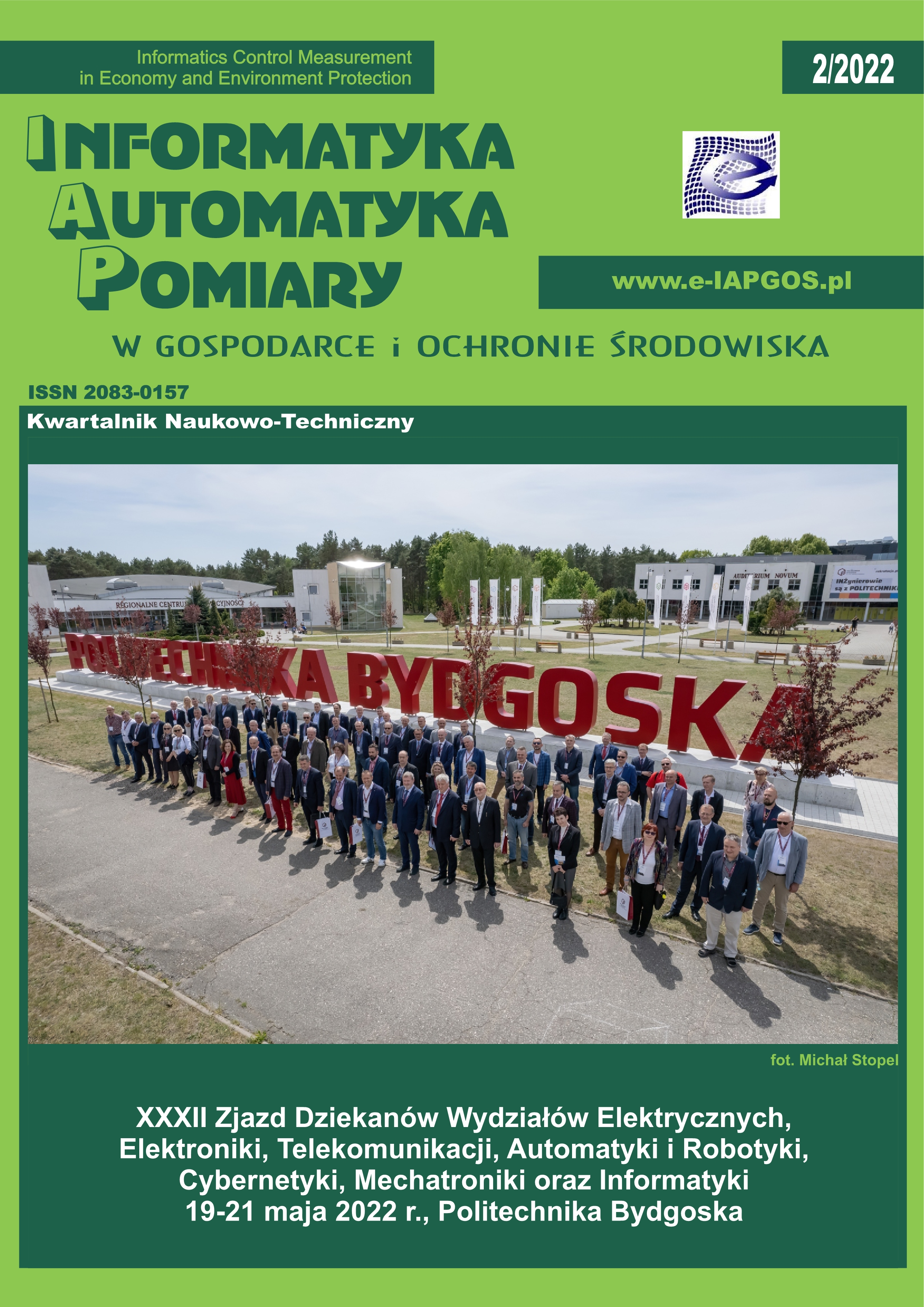
Numer Tom 12 Nr 2 (2022)
-
CKRIPT: NOWY JĘZYK SKRYPTOWY APLIKACJI INTERNETOWYCH
Wiktor Kania, Radosław Wajman4-9
-
WIELOKLASOWA KLASYFI KACJA Z NAM ION SK Ó RNYCH W OPARCIU O GŁĘBOKIE SIECI NEURONOW E
Magdalena Michalska10-14
-
SYNTEZA MATEMATYCZNYCH MODELI NIELINIOWYCH UKŁADÓW DYNAMICZNYCH Z WYKORZYSTANIEM RÓWNANIA CAŁKOWEGO VOLTERRY
Borys Mokin, Vitalii Mokin, Oleksandr Mokin, Orken Mamyrbaev, Saule Smailova15-19
-
METODA DŁUGOŚCI WIDMA W ILOŚCIOWEJ INTERPRETACJI WYBRANYCH WIDM OPTYCZNYCH
Martyna Wawrzyk20-23
-
ROZWÓJ AUTOMATYZACJI SORTOWANIA ODPADÓW JAKO INTEGRALNA CZĘŚĆ OCHRONY ŚRODOWISKA
Nataliia Stelmakh, Oleg Belman24-29
-
SPOSÓB OCENY PARAMETRÓW JAKOŚCI USŁUG TELEKOMUNIKACYJNYCH
Valentyn Zablotskyi, Yosyp Selepyna, Viktor Lyshuk, Natalia Yakymchuk, Anatolii Tkachuk30-33
-
NOWA METODA KALIBRACJI ON-LINE PRZETWORNIKA AC METODĄ KOLEJNYCH APROKSYMACJI
Serhii Zakharchenko, Tetiana Korobeinikova, Aigul Tungatarova, Bakhyt Yeraliyeva34-37
-
KONSTRUKCJA INNOWACYJNYCH SYSTEMÓW POMIAROWYCH W TOMOGRAFII ULTRADŹWIĘKOWEJ
Michał Gołąbek, Tomasz Rymarczyk38-42
-
SYMULACJA MATEMATYCZNA PRZETWORNIKA MIKROELEKTRONICZNEGO Z WYJŚCIEM CZĘSTOTLIWOŚCIOWYM DO POMIARU INDUKCJI POLA MAGNETYCZNEGO
Alexander Osadchuk, Iaroslav Osadchuk, Volodymyr Martyniuk, Lyudmila Krylik, Maria Evseeva43-49
-
BADANIE ODDZIAŁYWANIA ELEKTROMAGNETYCZNEGO NAPOWIETRZNYCH LINII PRZESYŁOWYCH 330 KV NA SYSTEMY EKOLOGICZNE
Veronika Cherkashina, Svitlana Litvinchuk, Vladyslav Lesko, Svetlana Kravets, Volodymyr Netrebskiy, Olena Sikorska, Orken Mamyrbayev, Baglan Imanbek50-55
-
WYZNACZANIE OPTYMALNEJ CZĘSTOTLIWOŚCI PIERWOTNYCH PRZETWORNIKÓW POMIAROWYCH DO POMIARU GRUBOŚCI POWŁOK DIELEKTRYCZNYCH NA POWIERZCHNIACH METALOWYCH
Kostyantyn Ovchynnykov, Oleksandr Vasilevskyi, Volodymyr Sevastianov, Yurii Polievoda, Aliya Kalizhanova, Bakhyt Yeraliyeva56-59
-
DYNAMIKA SYSTEMU STABILIZACJI PRĘDKOŚCI PRZENOŚNIKA PRZY ZMIENNYCH OBCIĄŻENIACH
Leonid Polishchuk, Oleh Khmara , Oleh Piontkevych, Oksana Adler, Aigul Tungatarova , Ainur Kozbakova60-63
-
O PRECYZYJNYM OBLICZANIU FAL AKUSTYCZNYCH W DZIEDZINIE CZĘSTOTLIWOŚCI
Tomasz Rymarczyk, Jan Sikora64-68
-
METODY WYKRYWANIA I WYRÓŻNIANIA OBSZARÓW W TEKSTUROWANYCH OBRAZACH BIOMEDYCZNYCH RAKA PIERSI
Ainur Orazayeva , Jamalbek Tussupov, Waldemar Wójcik, Sergii Pavlov, Gulzira Abdikerimova, Liudmyla Savytska69-72
-
SYMULACJE NUMERYCZNE PŁASKIEGO FANTOMU W BLISKIM POLU SYMETRYCZNEJ ANTENY DIPOLOWEJ
Monika Styła, Sebastian Styła73-76
-
ZASTOSOWANIE METOD BAYESOWSKICH DO MODELOWANIA ROZWOJU FARMAKOOPORNOŚCI U PACJENTÓW
Mariia A. Voronenko, Ulzhalgas M. Zhunissova, Saule S. Smailova, Luidmila N. Lytvynenko, Nataliia B. Savina, Pavlo P. Mulesa, Volodymyr I. Lytvynenko77-82
Archiwum
-
Tom 14 Nr 4
2024-12-21 25
-
Tom 14 Nr 3
2024-09-30 24
-
Tom 14 Nr 2
2024-06-30 24
-
Tom 14 Nr 1
2024-03-31 23
-
Tom 13 Nr 4
2023-12-20 24
-
Tom 13 Nr 3
2023-09-30 25
-
Tom 13 Nr 2
2023-06-30 14
-
Tom 13 Nr 1
2023-03-31 12
-
Tom 12 Nr 4
2022-12-30 16
-
Tom 12 Nr 3
2022-09-30 15
-
Tom 12 Nr 2
2022-06-30 16
-
Tom 12 Nr 1
2022-03-31 9
-
Tom 11 Nr 4
2021-12-20 15
-
Tom 11 Nr 3
2021-09-30 10
-
Tom 11 Nr 2
2021-06-30 11
-
Tom 11 Nr 1
2021-03-31 14
-
Tom 10 Nr 4
2020-12-20 16
-
Tom 10 Nr 3
2020-09-30 22
-
Tom 10 Nr 2
2020-06-30 16
-
Tom 10 Nr 1
2020-03-30 19
##plugins.themes.bootstrap3.article.main##
Authors
Abstrakt
Choroby skóry diagnozowane za pomocą dermatoskopii są coraz powszechniejsze. Wykorzytanie skomputeryzowanych systemów diagnostyki staje się niezwykle skuteczne. Nieiwazyjne metody diagnostyki, jakimi są głębokie sieci neuronowe są coraz powszechniejszym narzędziem badanym przez naukowców. W artykule przedstawiono przegląd wybranych głównych zagadnień związanych w procesem klasyfikacji wieloklasowej: etap wyboru bazy danych, wstępnego przetwarzania obrazów, doboru zestawu danych uczących, narzędzi klasyfikacji, etapu trenowania sieci i otrzymania wyników końcowych. Opisane działania zostały zaimplementowane za pomocą dostępnych głębokich sieci neuronowych. W artykule zwrócono uwagę na wyniki końcowe dostępnych modeli, takich jak skuteczność, specyficzność, dokładność klasyfikacji dla różnej ilości klas i dostępnych zestawów danych.
Słowa kluczowe:
Bibliografia
Aburaed N., Panthakkan A., Al-Saad M., Amin S. A., Mansoor W.: Deep convolutional neural network (DCNN) for skin cancer classification. Proceedings of the 2020 27th IEEE International Conference on Electronics, Circuits and Systems (ICECS), 2020, 1–4.
Adegun A., Viriri S.: Deep learning techniques for skin lesion analysis and melanoma cancer detection: a survey of state of the art. Artif Intell Rev 54, 2021, 811–841.
Al-masni M. A., Kim D., Kim T.: Multiple skin lesions diagnostics via integrated deep convolutional networks for segmentation and classification. Computer methods and programs in biomedicine 190, 2020, 105351.
Barata C., Celebi M., Marques J.: A survey of feature extraction in dermoscopy image analysis of skin cancer. IEEE Journal of Biomedical and Health Informatics 23(3), 2019, 1096–1109.
Brinker T. J., Hekler A., Enk A. H., Klode J., Hauschild A., Berking C.: Deep learning outperformed 136 of 157 dermatologists in a head-to-head der moscopic melanoma image classification task. Eur J Cancer 113, 2019, 47–54.
Cassidy B., Kendrick C., Brodzicki A., Jaworek-Korjakowska J., Yap M.: Analysis of the ISIC image datasets: usage, benchmarks and recommendations. Medical Image Analysis 75, 2022, 102305 [http://doi.org/10.1016/j.media.2021.102305].
Chaturvedi S. S., Gupta K., Prasad P. S.: Skin Lesion Analyser: An Efficient Seven-Way Multi-class Skin Cancer Classification Using MobileNet. Advances in Intelligent Systems and Computing 1141, Springer, Singapore, 2020 [http://doi.org/10.1007/978-981-15-3383-9_15].
Codella N. C. F., Nguyen B., Pankanti S., Gutman D., Helba B., Halpern A., Smith J. R.: Deep learning ensembles for melanoma recognition in dermoscopy images. IBM Journal of Research and Development 61(4/5), 173, 2017.
Dermofit Image Library https://licensing.edinburghinnovations.ed.ac.uk/i/software/dermofit-imagelibrary.html?item=dermofit-image-library (04.01.2021).
Ge Y., Li B., Zhao Y., Guan E., Yan W.: Melanoma segmentation and classification in clinical images using deep learning. ICMLC 2018: Proceedings of the 2018 10th International Conference on Machine Learning and Computing, 2018, 252–256.
Ge Z., Demyanov S., Chakravorty R., Bowling A., Garnavi R.: Skin disease recognition using deep saliency features and multimodal learning of dermoscopy and clinical images. Descoteaux M., Maier-Hein L., Franz A., Jannin P., Collins D. L., Duchesne S. (eds.), Springer, Cham LNCS 10435, 2017, 250–258.
Gessert N., Sentker T., Madesta F. et al.: Skin lesion classification using CNNs with patch-based attention and diagnosis-guided loss weighting. IEEE Trans. Biomed. Eng. 67, 2019, 495–503 [http://doi.org/10.1109/TBME.2019.2915839].
Haenssle H. A., Fink C., Schneiderbauer R., Toberer F., Buhl T., Blum A.: Man against machine: diagnostic performance of a deep learning convolutional neural network for dermoscopic melanoma recognition in comparison to 58 dermatologists. Ann Oncol 29, 2018, 1836–1342.
Haenssle H. A., Fink C., Toberer F. et al.: Man against machine reloaded: performance of a market-approved convolutional neural network in classifying a broad spectrum of skin lesions in comparison with 96 dermato-logists working under less artificial conditions. Ann Oncol 31, 2020, 137–143.
Hasan M. M., Elahi M., Alam M. A.: DermoExpert: Skin lesion classification using a hybrid convolutional neural network through segmentation, transfer learning, and augmentation. medRxiv, 2021. [http://doi.org/10.1101/2021.02.02.21251038].
Hekler A., Utikal J. S., Enk A. H., Solass W., Schmitt M., Klode J.: Deep learning outperformed 11 pathologists in the classification of histopathological melanoma images. Eur J Cancer 118, 2019, 91–96.
Howard A. G., Zhu M., Chen B., Kalenichenko D., Wang W., Weyand T., Andreetto M. Hartwig A.: MobileNets: Efficient convolutional neural networks for mobile vision applications. Computer Science, Computer Vision and Pattern Recognitionar, Xiv:1704.04861v1 [http://doi.org/10.48550/arXiv.1704.04861].
Huang G., Liu Z., Maaten L., Weinberger K.: Densely Connected Convolutional Networks. Computer Vision and Pattern Recognition arXiv:1608.06993v5. [http://doi.org/10.48550/arXiv.1608.06993].
Iqbal I., Younus M., Walayat K., Ullah Kakar M., Ma J.: Automated multi-class classification of skin lesions through deep convolutional neural network with dermoscopic images. Computerized Medical Imaging and Graphics 88, 2021, 101843 [http://doi.org/10.1016/j.compmedimag.2020.101843].
ISIC Archive https://www.isic-archive.com/#!/topWithHeader/onlyHeaderTop/gallery (23.03.2022).
Kareem O. S., Abdulazee A. M., Zeebaree D. Q.: Skin lesions classification using deep learning techniques: Review. Asian Journal of Research in Computer Science 9(1), 2021, AJRCOS.68652, 1–22.
Lopez A. R., Giro-i-Nieto X., Burdick J., Marques O.: Skin lesion classification from dermatoscopic images using deep learning techniques. Conference Paper 2017 [http://doi.org/JO.23J6/P.20l7.852-053].
Maglogiannis I., Doukas C. N.: Overview of advanced computer vision systems for skin lesions characterization. IEEE transactions on information technology in biomedicine 13(5), 2009, 721–733.
Mahbod A., Schaefe G., Ellinger, I., Ecker R., Pitiot A., Wang C.: Fusing fine tuned deep features for skin lesion classification. Comput. Med. Imaging Graph. 71, 2019, 19–29 [http://doi.org/10.1016/j.compmedimag.2018.10.007].
Majumder S., Ahsan Ullah M.: Feature extraction from dermoscopy images for an effective diagnosis of melanoma skin cancer. 10th International Conference on Electrical and Computer Engineering Bangladesh, 2018, 185–188.
Marchetti M. A., Liopyris K., Dusza S. W. et al.: Computer algorithms show potential for improving dermatologists’ accuracy to diagnose cutaneous melanoma: results of the international skin imaging collaboration 2017. J Am Acad Dermatol 82, 2020, 622–627.
Marchetti M. A., Codella N. C., Dusza S. W. et al.: Results of the 2016 international skin imaging collaboration international symposium on biomedical imaging challenge: comparison of the accuracy of computer algorithms to dermatologists for the diagnosis of melanoma from dermoscopic images. J Am Acad Dermatol 78, 2018, 270–277.
Marchetti M. A., Liopyris K., Dusza S. W., Codella N. C. F., Gutman D. A., Helba B.: Computer algorithms show potential for improving dermatologists’ accuracy to diagnose cutaneous melanoma: results of the international skin imaging collaboration 2017. J Am Acad Dermatol 82, 2020, 622–627.
Maron R. C., Weichenthal M., Utikal J. S., Hekler A., Berking C., Hauschild A.: Systematic outperformance of 112 dermatologists in multiclass skin cancer image classification by convolutional neural networks. Eur J Cancer 119, 2019, 57–65.
MED-NODE Dataset http://www.cs.rug.nl/~imaging/databases/melanoma_naevi/ (23.03.2022).
Nida N., Irtaza A., Javed A., Yousaf M., Mahmood M.: Melanoma lesion detection and segmentation using deep region based convolutional neural network and fuzzy C-means clustering. International Journal of Medical Informatics 124, 2019, 37–48.
PAD-UFES-20 Dataset https://data.mendeley.com/datasets/zr7vgbcyr2/1 (23.03.2022)
Panja A., Jackson J. Ch., Quadir Md. A.: An approach to skin cancer detection using keras and tensorflow. Journal of Physics: Conference Series 1911, 2021, 012032 [http://doi.org/10.1088/1742-6596/1911/1/012032].
PH2 Dataset, https://www.fc.up.pt/addi/ph2%20database.html (23.03.2022).
Qin Z., Liu Z., Zhu P., Xue Y.: A GAN-based image synthesis method for skin lesion classification. Computer Methods and Programs in Biomedicine, 2020, 105568.
Raza R., Zulfiqar F., Tariq S., Anwar G. B., Sargano A. B., Habib Z.: Melanoma classification from dermoscopy images using ensemble of convolutional neural networks. Mathematics 10(1), 2022, 26.
Rebouças Filho P. P., Peixoto S. A., Medeiros da Nobrega R. V., Hemanth D. J., Medeiros A. G., Sangaiah A. K., de Albuquerque V. H. C.: Automatic histologically-closer classification of skin lesions. Comput. Med. Imaging Graph. 68, 2018, 40–54 [http://doi.org/10.1016/j.compmedimag.2018.05.004].
Saeed J., Zeebaree S.: Skin lesion classification based on deep convolutional neural networks architectures. JASTT 2(01), 2021, 41–51.
Salian A. C., Vaze S., Singh P., Shaikh G. N., Chapaneri S., Dayaswal D.: Skin lesion classification using deep learning architectures. 2020 3rd International Conference on Communication System, Computing and IT Applications (CSCITA) IEEE, 2020, 168–173.
Sandler M., Howard A., Zhu M., Zhmoginov A., Chen L. C.: MobileNetV2: Inverted Residuals and Linear Bottlenecks. The IEEE Conference on Computer Vision and Pattern Recognition (CVPR), 2018, 4510–4520.
Srinivasu P. N., SivaSai J. G., Ijaz M. F., Bhoi A. K., Kim W., Kang J. J: Classification of skin disease using deep learning neural networks with MobileNet V2 and LSTM. Sensors 21, 2852, 2021.
Tschandl P., Codella N., Akay B. N. et al.: Comparison of the accuracy of human readers versus machine-learning algorithms for pigmented skin lesion classification: an open, webbased, international, diagnostic study. Lancet Oncol 2019b(20), 2019, 938-947.
Villa-Pulgarin J., Ruales-Torres A., Arias-Garzón D. et al.: Optimized Convolutional Neural Network Models for Skin Lesion Classification. Computers, Materials & Continua Tech Science Press, CMC 70(2), 2022, 2131–2148.
Wang Y., Cai J., Louie D., Wang J., Lee T.: Incorporating clinical knowledge with constrained classifier chain into a multimodal deep network for melanoma detection. Computers in Biology and Medicine 137, 2021, 104812.
Wei L., Ding K., Hu H.: Automatic Skin Cancer Detection in Dermoscopy Images based on Ensemble Lightweight Deep Learning Network. IEEE Access 8, 2020, 99633–99647.
Xiao F., Wu Q. Visual saliency based global–local feature representation for skin cancer classification. IET Image Processing 14(10), 2020, 2140–2148.
Young A. T., Xiong M., Pfau J., Keiser M. J, Wei M. L.: Artificial intelligence in dermatology: A Primer. Journal of Investigative Dermatology 140, 2020, 1504–1512.
Yu L., Chen H., Dou Q., Qin J., Heng P. A.: Automated melanoma recognition in dermoscopy images via very deep residual networks. IEEE Trans. Med. Imaging 36(4), 2017, 994–1004.
Zakład Epidemiologii i Prewencji Nowotworów Centrum Onkologii – Instytut w Warszawie. Krajowy Rejestr Nowotworów (KRN) http://onkologia.org.pl/ (02.08.2019).
Zhang J., Xie Y., Wu Q., Xia Y.: Skin lesion classification in dermoscopy images using synergic deep learning. Springer Nature Switzerland. LNCS 11071, 2018, 12–20.
##plugins.themes.bootstrap3.article.details##
Abstract views: 372
Downloads: 333
Licencja

Utwór dostępny jest na licencji Creative Commons Uznanie autorstwa – Na tych samych warunkach 4.0 Miedzynarodowe.



