

Can Wawel be superstructed? Reflections on the classification of monuments
Article Sidebar
Open full text
Issue No. 2 (2016)
-
Classification of monuments in Czech legislation
Monika Dąbkowska7-13
-
Can Wawel be superstructed? Reflections on the classification of monuments
Jacek Dąbrowski, Dariusz Jankowski15-26
-
Historic value measured in meters. Protection of monuments in the context of the Act on the Protection of Monuments and Protection of Monuments and the Construction Law
Helena Jadwiszczok-Molencka27-40
-
Cultural landscape as a category of monuments and its specificity
Lidia Klupsz41-56
-
Value assessment - a necessary stage for the protection of archaeological monuments
Marek Konopka57-66
-
Conservation works and the classification of monuments
Małgorzata Korpała67-78
-
Qualification of the value of the monument in the light of the law of the United States of America
Wojciech Kowalski79-90
-
On the beginning of the classification of monuments. On the advantages and disadvantages of Polish heritage valuation systems
Jakub Lewicki91-108
-
Pontiseum - a collection of historical exhibits that are outside the classification of monuments
Barbara Rymsza, Anna Mistewicz109-116
-
List of historic elements as a tool for valorization of a monument in the process of classification and categorization
Piotr M. Stępień117-119
-
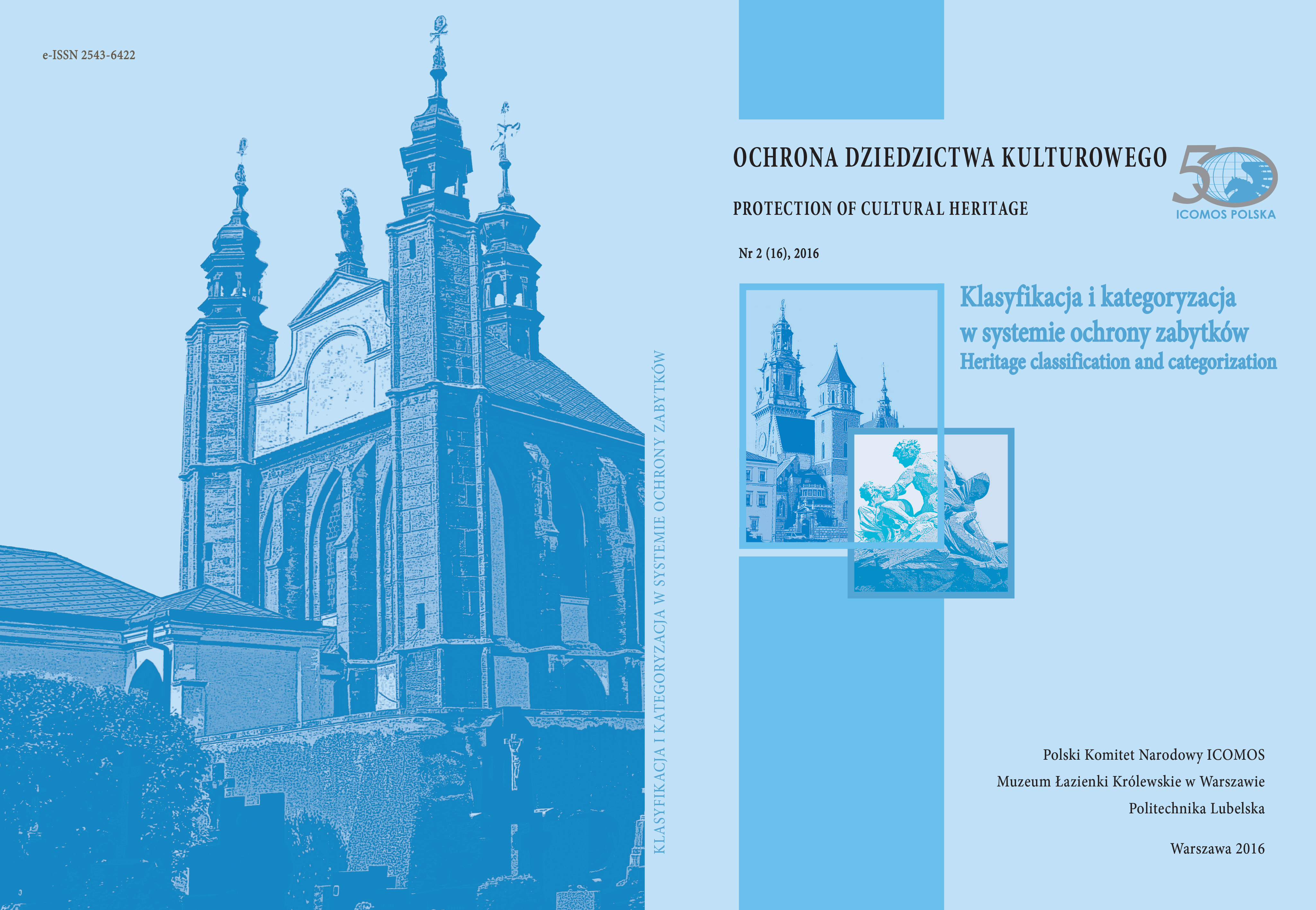
Classification and categorization in the system of monument protection
Bogusław Szmygin121-132
-
Are monuments of technology and engineering in Poland still a “second-class” heritage? Historical outline and current problems
Bartosz M. Walczak133-144
Main Article Content
DOI
Authors
Abstract
None of the legal acts applied in the Polish monument protection system, ranging from the Regency Council Decree of 1918 to the Act of 2003, allows for transforming historic monuments and sites. This provision applies, paradoxically, unless a competent historic preservation officer approves such transformations. In other words, under the aforementioned acts, it is possible to make any modification to the existing historic monument or site, provided that a historic preservation officer issues an appropriate permit.
Each of these legal acts provides framework for classifying historic monuments and sites, e.g. by introducing various forms of protection, classifying monuments and sites under various categories – immovable, movable, archaeological, etc. Therefore, classification is real.
There are so many different historic monuments and sites falling under a great number of categories that it is impossible to provide them with real, even diversified protection. It is therefore necessary to implement such
a classification of historic monuments and sites that would allow state and regional historic preservation officers and representatives of local government administration to carry out actions aimed at protecting properties and places of great historical significance.
The recommended classification is a starting point for discussing methods, criteria, and rules governing classification of historic monuments and sites. Additionally, it will ensure appropriate protection.
Keywords:
References
B. Rouba, Gdzie dziś jesteśmy my i nasze zabytki?, [w:] Wokół zagadnień estetyki zabytku po konserwacji i restauracji, red. E. Szmit-Naud, B. Rouba i J. Arszyńska, Warszawa-Toruń 2012.
Charatyńska M., Przebieg weryfikacji, [w:] Spis zabytków architektury i budownictwa, Warszawa 1964.
Dekret Rady Regencyjnej z dnia 31 października 1918 r. o opiece nad zabytkami sztuki i kultury (Dz. Praw Król. Polsk. Nr 16, poz. 36).
Janczykowski J., Prawna ochrona zabytków – teoria a praktyka. Uwagi wojewódzkiego konserwatora zabytków, [w:] Dlaczego i jak w nowoczesny sposób chronić dziedzictwo kulturowe, red. A. Rottermund, Warszawa 2014.
Karta Wenecka. Międzynarodowa Karta Konserwacji i Restauracji Zabytków Architektury i Miejsc Historycznych, Wenecja 25–31 maja 1964 r., [w:] Vademecum konserwatora zabytków. Międzynarodowe Normy Ochrony Dziedzictwa Kultury (edycja 2015), wybór tekstów i oprac. B. Szmygin, Warszawa 2015.
Krajowy program ochrony zabytków i opieki nad zabytkami na lata 2014–2017, Warszawa 2014. (http://bip.mkidn.gov.pl/modules/download_gallery/dlc.php?file=1919&id=1408369108).
Pismo okólne nr 14 Dyrektora Zarządu Muzeów i Ochrony Zabytków z dnia 30 grudnia 1963 r. w sprawie określania grup weryfikacyjnych zabytków nieruchomych wpisanych do rejestru zabytków (niepublikowane), [w:] Łazarowicz S., Sieroszewski W., Przepisy prawne dotyczące ochrony dóbr kultury oraz muzeów, Warszawa 1970.
Rozporządzenie Prezydenta Rzeczypospolitej Polskiej z dnia 6 marca 1928 r. o opiece nad zabytkami (Dz. U. Nr 29, poz. 265, z późn. zm.).
Szmygin B., Problemy ochrony zabytków – obecny stan oraz Zalecenia UNESCO w sprawie historycznego krajobrazu miejskiego, [w:] Dlaczego i jak w nowoczesny sposób chronić dziedzictwo kulturowe, red. A. Rottermund, Warszawa 2014.
Szmygin B., Współczesna doktryna konserwatorska – stan obecny i prognozy rozwoju, [w:] Doktryny i realizacje konserwatorskie w świetle doświadczeń krakowskich ostatnich 30 lat, red. B. Krasnowolski, Kraków 2011,
Ustawa z dnia 10 lutego 1962 r. o ochronie dóbr kultury (Dz. U. Nr 10, poz. 48, z późn. zm.).
Ustawa z dnia 23 lipca 2003 r. o ochronie zabytków i opiece nad zabytkami (Dz. U. z 2014 r. poz. 1446, z późn. zm.).
http://sjp.pwn.pl/szukaj/ochrona.html (dostęp: 11.2016 ).
Article Details
Abstract views: 347
Jacek Dąbrowski, Department of Monuments Protection, Ministry of Culture and National Heritage
archeolog, obecnie główny specjalista w Departamencie Ochrony Zabytków MKiDN. Zainteresowania: prawo ochrony zabytków, zabytki techniki, statystyka w ochronie zabytków, archeologia wczesnego średniowiecza.
Dariusz Jankowski, Department of Monuments Protection, Ministry of Culture and National Heritage
historyk sztuki, radca ministra w Departamencie Ochrony Zabytków MKiDN



