

Astronomical observations in the Inca Temple of Coricancha (Cusco)? A critical review of the hypothesis
Article Sidebar
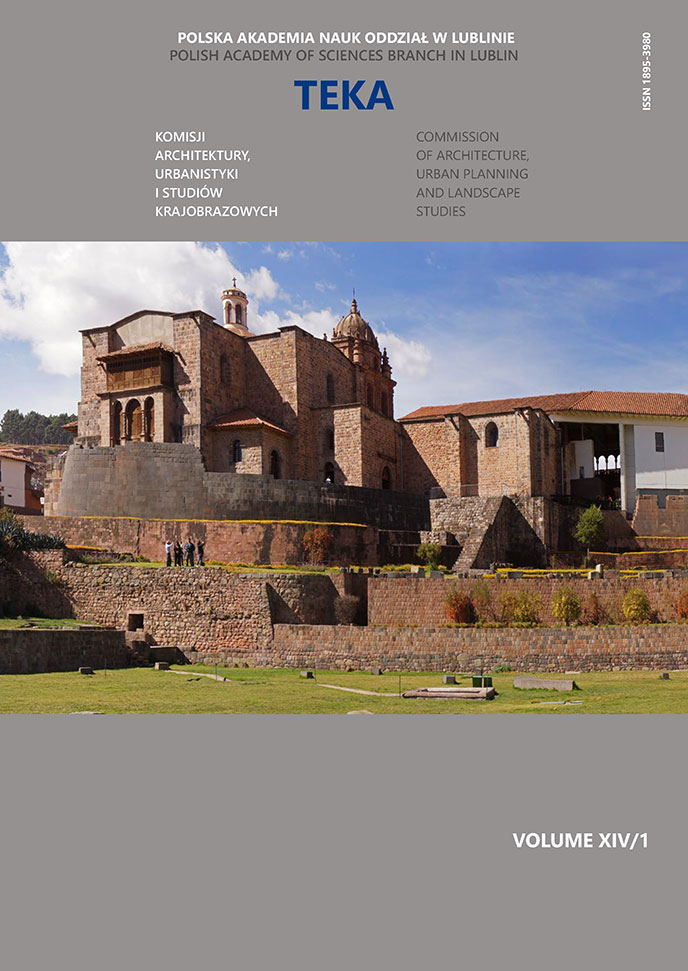
Issue Vol. 14 No. 1 (2018)
-
Astronomical observations in the Inca Temple of Coricancha (Cusco)? A critical review of the hypothesis
7-33
-
Lighting policy as an integral part of sustainable urban planning
34-43
-
Optical properties of opaque and light-transmitting photovoltaic systems in architecture and their influence on architectural form
44-54
-
Built environment of the tall housing buildings in Poland
55-62
-
Features of housing sanation in the historical architectural environment
63-70
-
Hypothetic Reconstruction of The Development of The Defensive Structures of The Middle Town of Rohatyn in 15th−17th Centuries
71-88
-
The modernization of public spaces in problematic residential areas exemplified on selected projects and realizations in the Bronowice district of Lublin
89-97
-
Project of revitalisation of the area next to the Potocki family Palace in Lublin
98-106
-
Classroom training strategies to strengthen the hotbed of research in architecture
107-115
-
Effect of accessibility in housing complexes on shaping of beauty in the urban environment. Selected examples from Cracow
116-125
-
Architecture in transition: the case study of the dormition catedral in Volodymyr Volynskyi
126-135
-
The earliest public green areas connected with Jelenia Góra, part. 1.
136-144
-
Overview and classification of housing forms intended for older and disable people occurring in high developed countries in context to deficit of similar forms in Poland
145-155
Main Article Content
Authors
Abstract
Coricancha (Qurikancha, Qorikancha) was the most important temple in Cuzco, the capital of Tawantinsuyu, the Inca Empire. The Spanish Conquistadores had the opportunity to see her, and her legendary richness, in November 1533, after entering Cuzco. Coricancha was the place to worship the most sacred effigies of the Inca cult, including the figure of the Sun, called Punchao. From this early period, there are also references, unfortunately not very precise, related to a specific orientation of some elements of the temple providing reflection of the rising (or setting) sun on the aforementioned figure of Punchao. Based on these sources, and the analysis of the remains of the original Inca Coricancha, a number of hypotheses regarding the possible astronomical function of this temple were formulated. Of particular importance was the hypothesis of Zuidema and Aveni, according to which astronomical observations at Coricancha constituted the structural skeleton of a specific Inca calendar cycle of 328 days. This article presents a critical analysis of this hypothesis, based on long-term research and measurements carried out in the Coricancha by the authors of the text.