

Issues of adapting design solutions to the needs of seniors and people with disabilities in teaching urban design
Article Sidebar
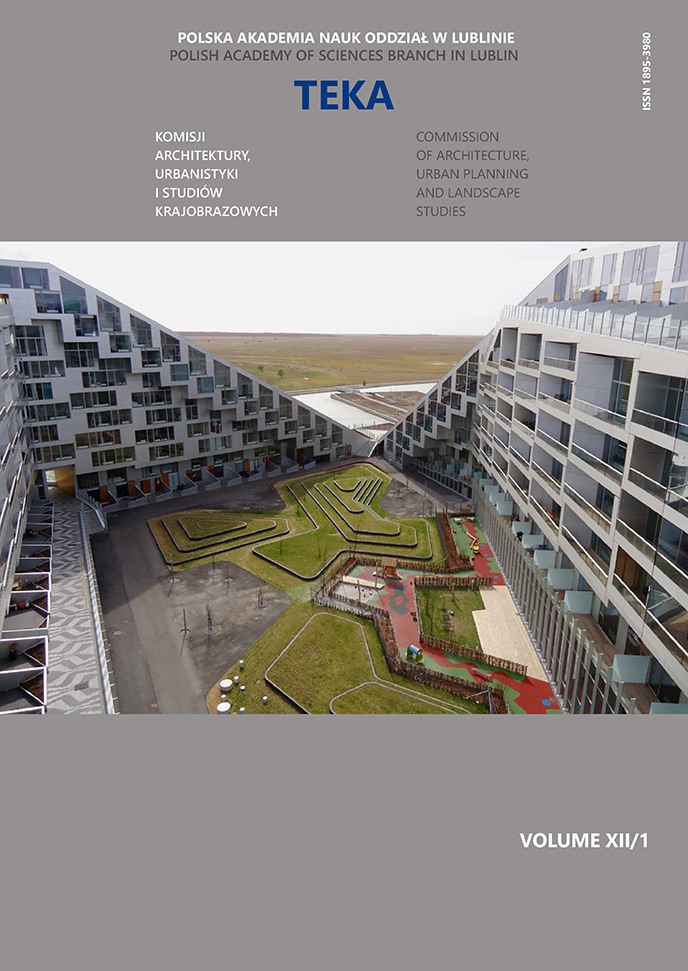
Issue Vol. 12 No. 1 (2016)
-
The impact of Unite d’Habitation on the formation of Superjednostka in Katowice
7-15
-
Historic alleys of Podlasie region – Droblin, Leśna Podlaska commune
16-21
-
Disability vs spatial planning and landscaping – selected examples
22-28
-
Natural ventilation and thermal comfort in public buildings
29-39
-
Issues of adapting design solutions to the needs of seniors and people with disabilities in teaching urban design
40-48
-
Multi-criterion comparative analysis – tool for the functional quality assessment of flats
Part I. The base of conducted examinations49-58 -
Complexity of city structure in reference to Barcelona
59-64
-
Role of imagination in a creativity process and a threats of the modern world
65-80
Main Article Content
Authors
Abstract
The paper presents the principles of Urban Design related to adapting design solutions for seniors and people with disabilities. After introducing the objectives of the topic as well as the expected results of teaching, it discusses substantive content of the issue of adapting open spaces to the needs of groups with various disabilities: wheelchair users, the deaf, people with hearing-impairement, the blind, visually impaired and the elderly. For the execution of those needs, informational outcome on urban array and sociometric pattern of individual housing unit, planned to instill reciprocal feelings of empathy and approval, are of utmost importance. The further part of the paper presents formal requirements, which should be taken into consideration in every project related to the scope of the subject matter – i.e., types of mandatory graphical representations along with examples of semester projects of the students.