

GŁĘBOKIE SIECI NEURONOWE DLA DIAGNOSTYKI ZMIAN SKÓRNYCH
##plugins.themes.bootstrap3.article.sidebar##
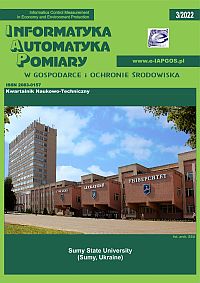
Numer Tom 12 Nr 3 (2022)
-
CHARAKTERYSTYKA ABSORPCJI PROMIENIOWANIA CIEPLNEGO DLA DWUTLENKU WĘGLA
Jan Kubicki, Krzysztof Kopczyński, Jarosław Młyńczak4-7
-
PRZEŁĄCZNIK-FILTR NA FALOWODZIE PROSTOKĄTNYM CZĘŚCIOWO WYPEŁNIONYM DIELEKTRYKIEM
Vitaly Pochernyaev, Natalia Syvkova, Mariia Mahomedova8-11
-
ZJAWISKO GIGANTYCZNEGO MAGNETOOPORU OBSERWOWANE W CIENKICH STRUKTURACH NiFe/Cu/NiFe
Jakub Kisała, Andrzej Kociubiński, Karolina Czarnacka, Mateusz Gęca12-15
-
ROZSZERZENIE STREFY PRAKTYCZNEGO ZASTOSOWANIA PLC O ARCHITEKTURĘ RÓWNOLEGŁĄ
Sergiy Tymchuk, Oleksiy Piskarev, Oleksandr Miroshnyk, Serhii Halko, Taras Shchur16-19
-
CECHY POMIARÓW DYNAMICZNYCH PRĘDKOŚCI KĄTOWEJ Z WYKORZYSTANIEM ENKODERA
Vasyl Kukharchuk, Waldemar Wójcik, Sergii Pavlov, Samoil Katsyv, Volodymyr Holodiuk, Oleksandr Reyda, Ainur Kozbakova, Gaukhar Borankulova20-26
-
ZASTOSOWANIE PREDYKCYJNEJ DIAGNOSTYKI W PRODUKCJI OPAKOWAŃ
Bogdan Palchevskyi, Lyubov Krestyanpol27-33
-
MODEL PROGNOZOWANIA SYSTEMÓW GRZEWCZYCH BUDYNKÓW UŻYTECZNOŚCI PUBLICZNEJ: PORÓWNANIE METODY SUPPORT VECTOR MACHINE I RANDOM FOREST
Andrii Perekrest, Vladimir Chenchevoi, Olga Chencheva, Alexandr Kovalenko, Mykhailo Kushch-Zhyrko, Aliya Kalizhanova, Yedilkhan Amirgaliyev34-39
-
NATURALNY MODEL SYMULACYJNY GENERACJI STACJI FOTOWOLTAICZNEJ W PROCESIE BILANSOWANIA ENERGII ELEKTRYCZNEJ W SYSTEMIE ELEKTROENERGETYCZNYM
Petr Lezhniuk, Viacheslav Komar, Iryna Hunko, Daniyar Jarykbassov, Dinara Tussupzhanova, Bakhyt Yeraliyeva, Nazbek Katayev40-45
-
APLIKACJA DO DIAGNOSTYKI WIBRACYJNEJ
Anzhelika Stakhova46-49
-
GŁĘBOKIE SIECI NEURONOWE DLA DIAGNOSTYKI ZMIAN SKÓRNYCH
Magdalena Michalska-Ciekańska50-53
-
MODELE DYNAMICZNE I MATEMATYCZNE HYDRAULICZNEGO URZĄDZENIA IMPULSOWEGO DO CIĘCIA WIBRACYJNEGO Z GENERATOREM IMPULSÓW WBUDOWANYM W SPRĘŻYNĘ PIERŚCIENIOWĄ
Roman Obertyukh, Andrіі Slabkyі, Leonid Polishchuk, Oleksandr Povstianoi, Saule Kumargazhanova, Maxatbek Satymbekov54-58
-
EKSPERCKIE SYSTEMY ROZMYTE DO OCENY INTENSYWNOŚCI REAKTYWNEGO OBRZĘKU TKANEK MIĘKKICH U PACJENTÓW Z CUKRZYCĄ
Liudmyla Shkilniak, Waldemar Wójcik, Sergii Pavlov, Oleg Vlasenko, Tetiana Kanishyna, Irina Khomyuk, Oleh Bezverkhyi, Sofia Dembitska, Orken Mamyrbayev, Aigul Iskakova59-63
-
SYMULACJA ZAGROŻEŃ BEZPIECZEŃSTWA INFORMACJI W ZAKRESIE DOSTĘPNOŚCI DOKUMENTÓW PROJEKTOWYCH W OPARCIU O LOGIKĘ ROZMYTĄ
Oleksii M. Shushura, Liudmyla A. Asieieva, Oleksiy L. Nedashkivskiy, Yevhen V. Havrylko, Yevheniia O. Moroz, Saule S. Smailova, Magzhan Sarsembayev64-68
-
ZARZĄDZANIE MIEJSCEM PRACY ZA POMOCĄ BADAŃ OPERACYJNYCH
Nataliia Geseleva, Ganna Proniuk, Olexander Romanyuk, Olga Akimova, Tetiana Troianovska-Korobeynikova, Liudmyla Savytska, Saule Rakhmetullina, Nurbapa Mekebayev69-73
-
MODELOWANIE POTENCJAŁU SIŁY ROBOCZEJ UKRAINY: BUDOWANIE BAZY WIEDZY
Ivan V. Zayukov, Iryna M. Kobylianska, Alexandr Kobylianskyi, Sofia V. Dembitska74-78
Archiwum
-
Tom 14 Nr 4
2024-12-21 25
-
Tom 14 Nr 3
2024-09-30 24
-
Tom 14 Nr 2
2024-06-30 24
-
Tom 14 Nr 1
2024-03-31 23
-
Tom 13 Nr 4
2023-12-20 24
-
Tom 13 Nr 3
2023-09-30 25
-
Tom 13 Nr 2
2023-06-30 14
-
Tom 13 Nr 1
2023-03-31 12
-
Tom 12 Nr 4
2022-12-30 16
-
Tom 12 Nr 3
2022-09-30 15
-
Tom 12 Nr 2
2022-06-30 16
-
Tom 12 Nr 1
2022-03-31 9
-
Tom 11 Nr 4
2021-12-20 15
-
Tom 11 Nr 3
2021-09-30 10
-
Tom 11 Nr 2
2021-06-30 11
-
Tom 11 Nr 1
2021-03-31 14
-
Tom 10 Nr 4
2020-12-20 16
-
Tom 10 Nr 3
2020-09-30 22
-
Tom 10 Nr 2
2020-06-30 16
-
Tom 10 Nr 1
2020-03-30 19
##plugins.themes.bootstrap3.article.main##
Authors
Abstrakt
Nieinwazyjna diagnostyka nowotworów skóry jest niezwykle potrzebna. W ostatnich latach bardzo dużym zainteresowaniem w diagnostyce chorób skóry cieszą się głębokie sieci neuronowe i transfer learning. Artykuł zawiera wybrane podstawy głębokich sieci neuronowych, ich ciekawe zastosowania stworzone w ostatnich latach, pozwalające na klasyfikację zmian skórnych z dostępnych obrazów dermatoskopowych.
Słowa kluczowe:
Bibliografia
Abunadi I., Senan E. M.: Deep learning and machine learning techniques of diagnosis dermoscopy images for early detection of skin diseases. Electronics 10, 3158, 2021.
Al-Masni M. A., Kim D. H., Kim T. S:. Multiple skin lesions diagnostics via integrated deep convolutional networks for segmentation and classification. Comput Methods Programs Biomed. 190, 105351, 2020.
Brinker T. J. et al: Deep learning outperformed 136 of 157 dermatologists in a head-to-head der moscopic melanoma image classification task. Eur J Cancer 113, 47–54, 2019.
Chaturvedi S. S., Gupta K., Prasad P. S.: Skin lesion analyser: An efficient seven-way multi-class skin cancer classification using MobileNet. Advances in Intelligent Systems and Computing 1141, Springer, Singapore, 2020.
Codella N. C. F. et al.: Deep learning ensembles for melanoma recognition in dermoscopy images. IBM Journal of Research and Development 61(4/5), 173, 2017.
DERMOFIT IMAGE LIBRARY [https://licensing.edinburghinnovations.ed.ac.uk/i/software/dermofit-imagelibrary.html?item=dermofit-image-library] (accessed 04.01.2021).
Gavrilov D., Lazarenko L., Zakirov E.: AI recognition in skin pathologies detection. Proceedings of the 2019 International Conference on Artificial Intelligence: Applications and Innovations (IC-AIAI), 554–542, Belgrade 2019.
Ge Y. et al.: Melanoma segmentation and classification in clinical images using deep learning. 10th International Conference on Machine Learning and Computing ICMLC, 2018, 252–256.
Gessert N. et al.: Skin lesion classification using CNNs with patch-based attention and diagnosis-guided loss weighting. IEEE Trans. Biomed. Eng. 67, 495–503, 2020.
Haenssle H. A. et al: Man against machine reloaded: performance of a market-approved convolutional neural network in classifying a broad spectrum of skin lesions in comparison with 96 dermato-logists working under less artificial conditions. Ann Oncol 31, 137–143, 2020.
Harangi B.: Skin lesion classification with ensembles of deep convolutional neural networks. J. Biomed. Inform. 86, 25–32, 2018.
Hasan M. M., Elahi M., Alam M. A.: DermoExpert: Skin lesion classification using a hybrid convolutional neural network through segmentation, transfer learning and augmentation. medRxiv 2021.02.02.21251038.
He K. et al.: Deep residual learning for image recognition. IEEE Conference on Computer Vision and Pattern Recognition (CVPR) 2016, 770–778.
Hekler A. et al.: Deep learning outperformed 11 pathologists in the classification of histopathological melanoma images, Eur J Cancer 118, 91–96, 2019.
Howard A. G. et al.: MobileNets: Efficient convolutional neural networks for mobile vision applications. Computer Science, Computer Vision and Pattern Recognition, arXiv:1704.04861v1.
Huang G. et al.: Densely Connected Convolutional Networks. Computer Vision and Pattern Recognition arXiv:1608.06993v5.
Iqbal I. et al.: Automated multi-class classification of skin lesions through deep convolutional neural network with dermoscopic images. Computerized Medical Imaging and Graphics 88, 101843, 2021.
ISIC Archive [https://www.isic-archive.com/#!/topWithHeader/onlyHeaderTop/gallery] (accessed 23.03.2022).
Kareem O., Mohsin Abdulazeez A., Zeebaree D.: Skin Lesions Classification Using Deep Learning Techniques: Review. Asian Journal of Research in Computer Science 9(1), 1–22, 2021.
Lee S. et al.: Augmented decision-making for acrallentiginous melanoma detection using deep convolutional neural networks. J. Eur. Acad. Dermatol. Venereol. 34, 1842–1850, 2020.
Lopez A. R. et al.: Skin lesion classification from dermatoscopic images using deep learning techniques. 13th International Conference on Biomedical Engineering (BioMed) IASTED, 2017, 49–54.
Maglogiannis I., Doukas C. N.: Overview of advanced computer vision systems for skin lesions characterization, IEEE transactions on information technology in biomedicine 13(5), 721–733, 2009.
Mahbod A. et al.: Fusing finetuned deep features for skin lesion classification, Comput. Med. Imaging Graph. 71, 19–29, 2019.
Mahdianpari M. et al.: Very deep convolutional neural networks for complex land cover mapping using multispectral remote sensing imagery. Remote Sens. 10(7), 2018.
Marchetti M. A. et al.: Computer algorithms show potential for improving dermatologists’ accuracy to diagnose cutaneous melanoma: results of the international skin imaging collaboration 2017. J Am Acad Dermatol 82, 622–627, 2020.
Maron R. C. et al.: Systematic outperformance of 112 dermato-logists in multiclass skin cancer image classification by convo-lutional neural networks, Eur J Cancer 119, 57–65, 2019.
MED-NODE Dataset [http://www.cs.rug.nl/~imaging/databases/melanoma_naevi/] (accessed 23.03.2022).
Nida N. et al.: Melanoma lesion detection and segmentation using deep region based convolutional neural network and fuzzy C-means clustering, International Journal of Medical Informatics 124, 37–48, 2019.
PAD-UFES-20 Dataset [https://data.mendeley.com/datasets/zr7vgbcyr2/1] (accessed: 23.03.2022).
PH2 Dataset [https://www.fc.up.pt/addi/ph2%20database.html] (accessed 23.03.2022).
Qin Z. et al.: A GAN-based image synthesis method for skin lesion classification. Computer Methods and Programs in Biomedicine, 105568, 2020.
Raza R. et al.: Melanoma Classification from dermoscopy images using ensemble of convolutional neural networks. Mathematics 10, 26, 2022.
Sandler M. et al.: MobileNetV2: Inverted Residuals and Linear Bottlenecks. IEEE Conference on Computer Vision and Pattern Recognition (CVPR), 2018, 4510–4520.
Simonyan K., Zisserman A.: Very deep convolutional networks for large-scale image recognition. International Conference on Learning Representations ICLR, 2015.
Szegedy C. et al.: Inception-v4, Inception-ResNet and the impact of residual connections on learning. AAAI, 4278–4284, 2017.
Tschandl P. et al.: Comparison of the accuracy of human readers versus machine-learning algorithms for pigmented skin lesion classification: an open, webbased, international, diagnostic study. Lancet Oncol 2019b(20), 938–947, 2019.
Villa-Pulgarin J. et al.: Optimized convolutional neural network models for skin lesion classification, Computers, Materials & Continua Tech Science Press, CMC 70(2), 2022
Yu C. et al.: Acral melanoma detection using a convolutional neural network for dermoscopy images. PLoS ONE 2018, 13, e0193321, 2018.
Zakład Epidemiologii i Prewencji Nowotworów Centrum Onkologii – Instytut w Warszawie. Krajowy Rejestr Nowotworów (KRN) [http://onkologia.org.pl/] (accessed 02.08.2019).
##plugins.themes.bootstrap3.article.details##
Abstract views: 417
Downloads: 475
Licencja

Utwór dostępny jest na licencji Creative Commons Uznanie autorstwa – Na tych samych warunkach 4.0 Miedzynarodowe.



