

The perspectives of protection of the world heritage in Poland – the tentative list and proposals of nominations to the world heritage list
Article Sidebar
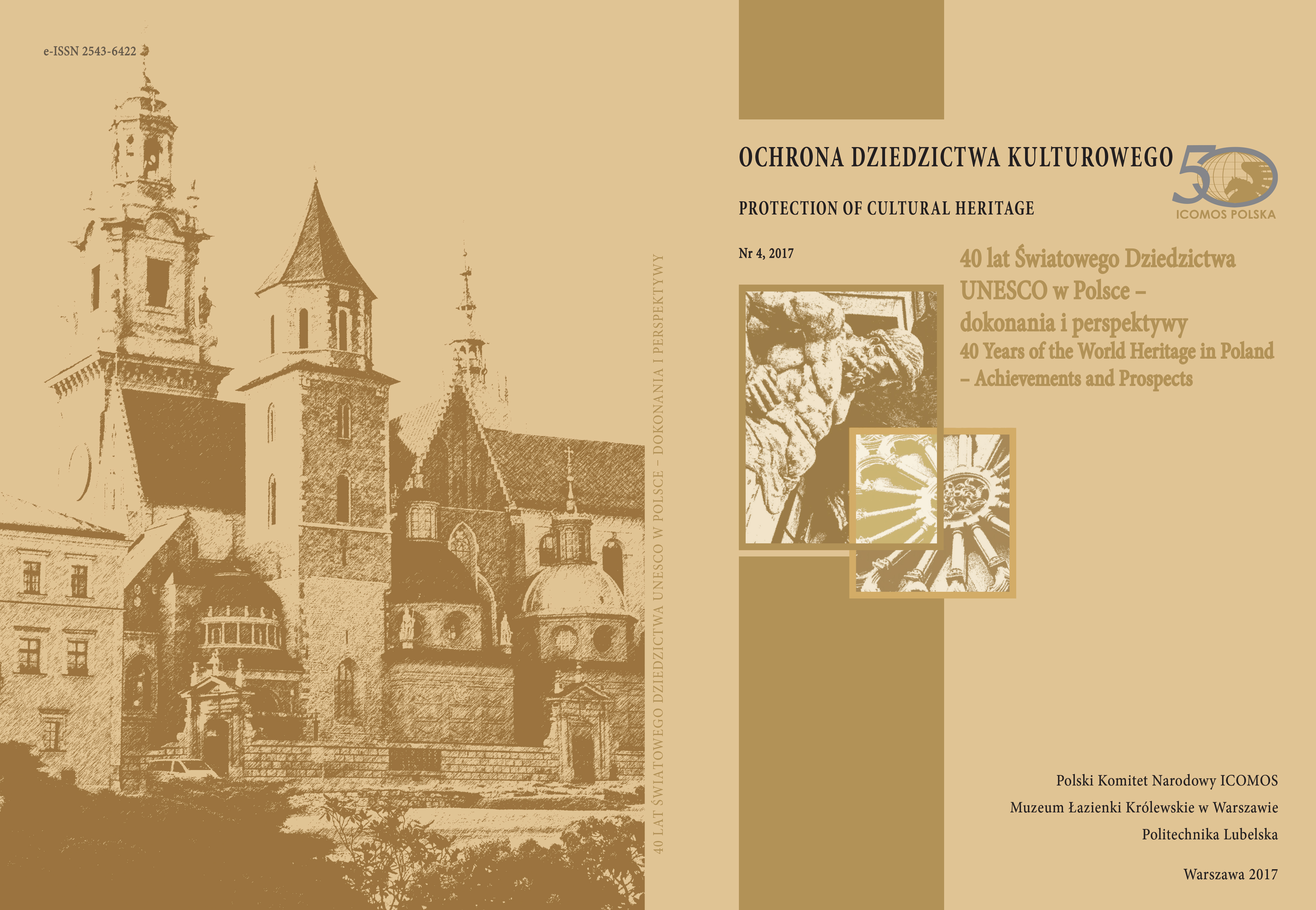
Issue No. 4 (2017)
-
Civic Committee for the Restoration of Cracow Heritage: origin, experience, programme
7-14
-
Historic monument – the Gniezno Cathedral – the dominant monument of the city landscape now and in the past
15-20
-
Cultural landscape on the World Heritage List - Polish experiences
21-30
-
Adaptation of buildings of historical significance in Gdańsk. The key issues of Regional Heritage Protection Officers’ perspective
31-46
-
Prospects for inscribing certain elements of the cultural landscape of Szczecin as a Polish listed monument
47-62
-
Gdańsk on the UNESCO World Heritage List - 20 years of attempts and missed opportunities
63-72
-
Consequences of entering assets into the UNESCO List – prestige and what next?
73-81
-
Churches of Peace in Jawor and Świdnica – conservation work of the interior and furnishings, as an example of protecting buildings inscribed on the World Heritage List
83-92
-
The authenticity of painted decorations of the Old Town in Warsaw
93-103
-
Management Plans for the Churches of Peace in Jawor and Swidnica as an Example of Management Problems with UNESCO World Heritage Site
105-120
-
Ideas and assumptions of The Convention concerning the Protection of World Cultural and Natural Heritage and their implementation in Poland from the perspective of the Polish UNESCO Committee
121-126
-
Poland’s participation in initial efforts to implement resolutions of the Convention
127-134
-
The perspectives of protection of the world heritage in Poland – the tentative list and proposals of nominations to the world heritage list
129-142
-
Places of memory under UNESCO 1972 World Heritage Convention and criterion VI of the Op erational Guidelines of its implementation
149-162
-
The role of the “League of Polish Cities and UNESCO Sites” in the preservation of Cultural Heritage
163-165




Main Article Content
Authors
Abstract
The article discusses Polish suggestions of new inscriptions into the UNESCO World Heritage List. The waiting items mentioned in the Tentative List were presented. Currently the Polish version of the List numbers 5 items. They are: Gdańsk, Town of Memory and Freedom (2005), The Augustów Canal (2006), The Dunajec River Gorge in the Pieniny Mountains (2006), Extension to the Joint World Heritage Property “Primeval Beech Forests of the Carpathians (Slovak Republic and Ukraine) and the Ancient Beech Forests of Germany (Germany)” (2015), “Krzemionki”, prehistoric flint mines (2016). Other offered suggestions were also presented: The Jewish Cemetery in Łodz, the Ponds in Milicz – medieval fishponds in central Europe, Nowa Huta, the paper mill – Duszniki Zdrój, the Elbląg Canal, Nikiszowiec as a factory-related housing complex, the cultural landscape of Żuławy area, wooden mosques in the Podlasie Region – Bohoniki and Kruszyniany, the Valley of Palaces and Gardens – the Jeleniogórska Valley, Żyrardów, Warsaw Water Filters and Księży Młyn in Łodz as industrial heritage, the Citadel in Warsaw, and the Słowiński National Park as natural heritage. Among new suggestions the following were indicated: the collegiate church in Pułtusk as an example of Renaissance solutions of linear perspective applied in architecture, the project of a Gothic vault in the church in Szydłowiec as a unique example of the Gothic construction workmanship, and modern wooden churches (e.g. the church in Boguszyce).