

Hammershus Castle - "Good Practices" and Managing Permanentl Ruin
Article Sidebar
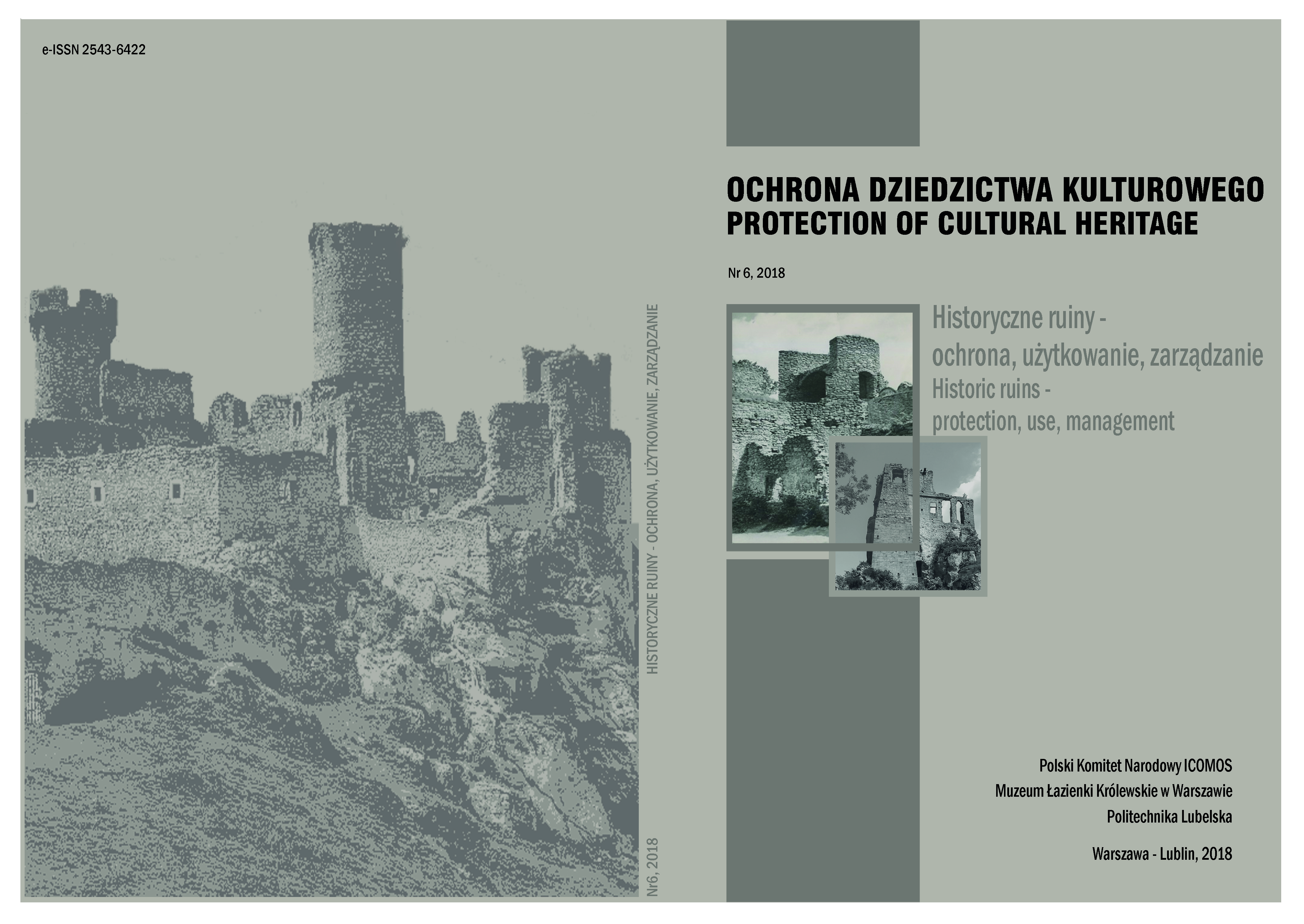
Open full text
Issue No. 6 (2018)
-
Protection of historical ruins - research and project problems on the example of the castle in Sochaczew
Maria Brykowska11-27
-
Protecting and displaying walls of the Człuchów Castle - former practices and current issues
Grzegorz Bukal29-42
-
Ambiguous role of post-industrial ruins in the cultural landscape of Poland
Jacek Dąbrowski, Bartosz M. Walczak43-52
-
The attractiveness of a permanent (durabel) ruin. Contemporary functioning of the historical ruins of castles in Małopolska
Paweł Dettloff53-71
-
Stocktaking methods of facilities in a state of ruin
Katarzyna Drobek, Bartosz Szostak, Wojciech Królikowski73-86
-
Charter on the Protection of Historic Ruins – theory and practice. Examples from Lesser Poland
Jan Janczykowski87-95
-
Urban design concepts of ruins in Gdańsk historical area
Agnieszka Kowalska97-104
-
Protection of historical ruins on the Polish-German border. A case of cultural heritage of the former Duchy of Pomeranian
Izabela Kozłowska, Agnieszka Lamprecht105-116
-
Protection and preservation of ruins - changes in the methods used in the Mazovian region
Jakub Lewicki117-134
-
'Foundation of Memory'. About the experience of space and remnants of the former concentration camp at the Kl Plaszow memorial site
Tomasz Owoc, Kamil Karski135-143
-
Some forts of Cracow Fortress become historical ruins. Purpose or necessity
Halina Rojkowska-Tasak145-151
-
Castle in Siewierz. Preservation and revalorisation of the historic ruins
Artur Rok153-162
-
Hammershus Castle - "Good Practices" and Managing Permanentl Ruin
Andrzej Siwek, Magdalena Trafas-Wołoszyn163-176
-
Selected issues of the investment process implementation in historic buildings on the example of the Castle of the Dukes of Mazovia in Ciechanów
Antoni Krzysztof Sobczak177-190
-
Protection of historic ruins - objectives for theory and practice
Bogusław Szmygin191-200
-
Biological corrosion and vegetation in the aspect of permanent ruin
Maciej Trochonowicz, Beata Klimek, Daniel Lisiecki201-212
-
Salt mill complex and warehouses of the former salt mine in Wapno. Considerations and premises for the protection of 20th-century post-industrial buildings as a permanent ruin
Miron Urbaniak213-223
Main Article Content
DOI
Authors
Abstract
Hammershus is a medieval Danish castle on the Bornholm island. In 1743 Hammershus was finally abandoned as a stronghold. The fortress was partially demolished around 1750. The ruins were put on the national historic register in 1822. From 1885, until his death in 1928, P. C. Hauberg was in charge of the extensive restoration work. After that, the castle remained a picturesque ruin. The conservation policy, which was taken from 1907, includes the purchase of land around the castle and systematic removal of the surrounding buildings. In 1969 Jørn Utzon created the concept of the information center hidden in the landscape. In 2013, his concept was implemented. The project was developed by the Danish team Arkitema, in cooperation with Buro Happold, and Ch. Harlang. The modern information center put into use in 2018. Building is removed from the ruins and hidden in the nearby slope. The protection of Hammershus Castle is subordinated to preserving its historical form - a permanent ruin. It is also conducted in the landscape sphere. The new reception center was located and designed so as to not compete with the historical ruin and landscape. The Hammershus castle management model is an example of good practice in protecting cultural heritage and historic ruins. The main point is to use the attractiveness of the historical ruins, as an object that attracts visitors.The remoteness of modern commercial functions from the monument create new possibilities for contemplating the castle ruins and contributes to strict landscape protection.
Keywords:
References
Fabritius E., Danish Artists' Colonies, Skagens Museum, 2007.
Geremek R., Zamek w ruinie jest hołdem dla najeźdźcy, http://www.fronda.pl/a/zamek-w-ruinie-jest-holdem-dla-najezdzcy,13215.html.
Jensen B., Bornholm – Danmarks ferieø, Bornholms Museum 2016, Landscape painting on Bornholm, Bornholms Kunstmuseum, http://www.bornholms-kunstmuseum.dk/udforsk/bornholms-kunsthistorie/landskabsmaleriet-paa-bornholm.aspx.
Jokilehto J., A History of Architectural Conservation, York 1986.
Kadłuczka A., Conservatio est continua creatio – or the doctrine of heritage protection as a component of existential space, Wiadomosci Konserwatorskie – Journal of Heritage Conservation 2015.
Karta ochrony historycznych ruin, /zasady ochrony historycznych ruin/ przyjęta Uchwałą Walnego Zgromadzenia Członków PKN ICOMOS w dniu 4 grudnia 2012 r., http://www.icomos-poland.org/pl/dokumenty/uchwaly/130-karta-ochrony-historycznych-ruin.html.
Konferencja PKN ICOMOS, Historic ruins – protection, use, management Kraków, 8-10 listopad 2018, http://www.icomos-poland.org/pl/archiwum-aktualnosci/249-scientific-conference-historic-ruins-protection-use-management-cracow-8-10-november-2018.html.
Konferencja PKN ICOMOS, Historyczne Ruiny - Ochrona, Użytkowanie, Zarządzanie - 16-17 kwietnia 2018 r. Łazienki Królewskie w Warszawie, http://www.icomos-poland.org/pl/archiwum-aktualnosci/239-konferencja-naukowa-historyczne-ruiny-ochrona-uzytkowanie-zarzadzanie-16-17-kwietnia-2018-r-lazienki-krolewskie-w-warszawie.html.
Kosiewski P., Krawczyk J., Zabytek i historia. Wokół problemów konserwacji i ochrony zabytków w XIX wieku. Antologia, Warszawa 2007.
Loschwitz-Himmel G., New Visitor Centre for Hammershus, Topos 28.04.2014; https://www.toposmagazine.com/new-visitor-centre-hammershus/.
Meldgaard K., Hammershus, 2007.
Ochrona i konserwacja ruin zamkowych : wybrane problemy i przykłady, B. Szmygin, P. Molski (red.), Warszawa - Lublin 2013.
Przyłęcki M., Jasieńko J., Zabytek w trwałej ruinie. Ochrona, konserwacja i ekspozycja. Program Śląskiego Oddziału Stowarzyszenia Konserwatorów Zabytków, Wrocław 2001.
Ratajczak T., Nowy zamek w Poznaniu – negatywny przykład adaptacji reliktów średniowiecznej architektury, [w:] Zamki w runie – zasady postępowania konserwatorskiego, B. Szmygin, P. Molski (red.), Warszawa-Lublin 2012.
Ratajczak T., Zamki na nowo. Blog poświęcony odbudowie historycznych zamków w Polsce, https://zamkinanowodotcom.wordpress.com/.
Rekomendacja Warszawska o odbudowie dziedzictwa kulturowego zniszczonego na skutek konfliktów zbrojnych i kataklizmów naturalnych, http://www.icomos-poland.org/pl/archiwum-aktualnosci/254-rekomendacja-warszawska-o-odbudowie-dziedzictwa-kulturowego-zniszczonego-na-skutek-konfliktow-zbrojnych-i-kataklizmow-naturalnych.html.
Seehusen Ch., Hmmershus og Bornholms andre borge, Bornholms Museum 2017.
Seminarium Narodowego Instytutu Dziedzictwa, Fortyfikacje pomiędzy Bałtykiem a Morzem Czarnym. Zarządzanie i ochrona dziedzictwa obronnego, 21-23 czerwca 2017, Gdańsk, https://www.nid.pl/pl/O_NID/Sprawozdania/Sprawozdanie%20z%20dzia%C5%82alno%C5%9Bci%20NID%20w%202017%20roku.pdf.
Seminarium Narodowego Instytutu Dziedzictwa, Międzynarodowe seminarium „Zamki Pomorza – przykład rewitalizacji zabytków rezydencjonalno-obronnych, 6-10 września 2016, https://www.nid.pl/pl/Dla_specjalistow/Aktualnosci/news.php?ID=3301&sphrase_id=52506.
Sillehoved S. P., Hammershus, Bornholms Tidendes Forlag 2014.
Skaarup J. Ch., De Bornholmske Kystskanser, Bornholms Forsvarsmuseum 2016.
Stemann I., Danja. Kraj i naród, Warszawa 1926.
Taylor J., Arkitema Wins Competition for a Visitor Centre at Hammershus, 28 Nov 2013, ArchDaily; https://www.archdaily.com/452798/arkitema-wins-competition-for-a-visitor-centre-at-hammershus/.
Zamki w ruinie - zasady postępowania konserwatorskiego, B. Szmygin, P. Molski (red.), Warszawa - Lublin 2012
Zamki, grody, ruiny – waloryzacja i ochrona, M. L. Lewicka (red.), Seria Architektura Obronna: t. III, Warszawa – Białystok 2009.
http://bornholmske-samlinger.dk/.
http://www.bornholmerneshistorie.dk/hotel-hammershus.html.
Article Details
Abstract views: 271
Andrzej Siwek, Institute of Art History, Jagiellonian University in Cracow
absolwent Uniwersytetu Jagiellońskiego - historyk (1987) i historyk sztuki (1991). Doktorat w dziedzinie architektura i urbanistyka (Politechnika Krakowska 2014). Od 2006 kieruje Oddziałem Terenowym Narodowego Instytutu Dziedzictwa w Krakowie. Dydaktyk w Zakładzie Ochrony Dóbr Kultury Instytutu Historii Sztuki UJ. Zainteresowany refleksją teoretyczną z zakresu ochrony dziedzictwa kulturowego.
Magdalena Trafas-Wołoszyn, Voivode's Office for the Protection of Monuments in Cracow
absolwentka Uniwersytetu Jagiellońskiego - archeolog. Główny specjalista w Wojewódzkim Urzędzie Ochrony Zabytków w Krakowie. Autorka publikacji i wystąpień na temat praktyki i teorii ochrony historycznych budowli obronnych.



