

Biological corrosion and vegetation in the aspect of permanent ruin
Article Sidebar
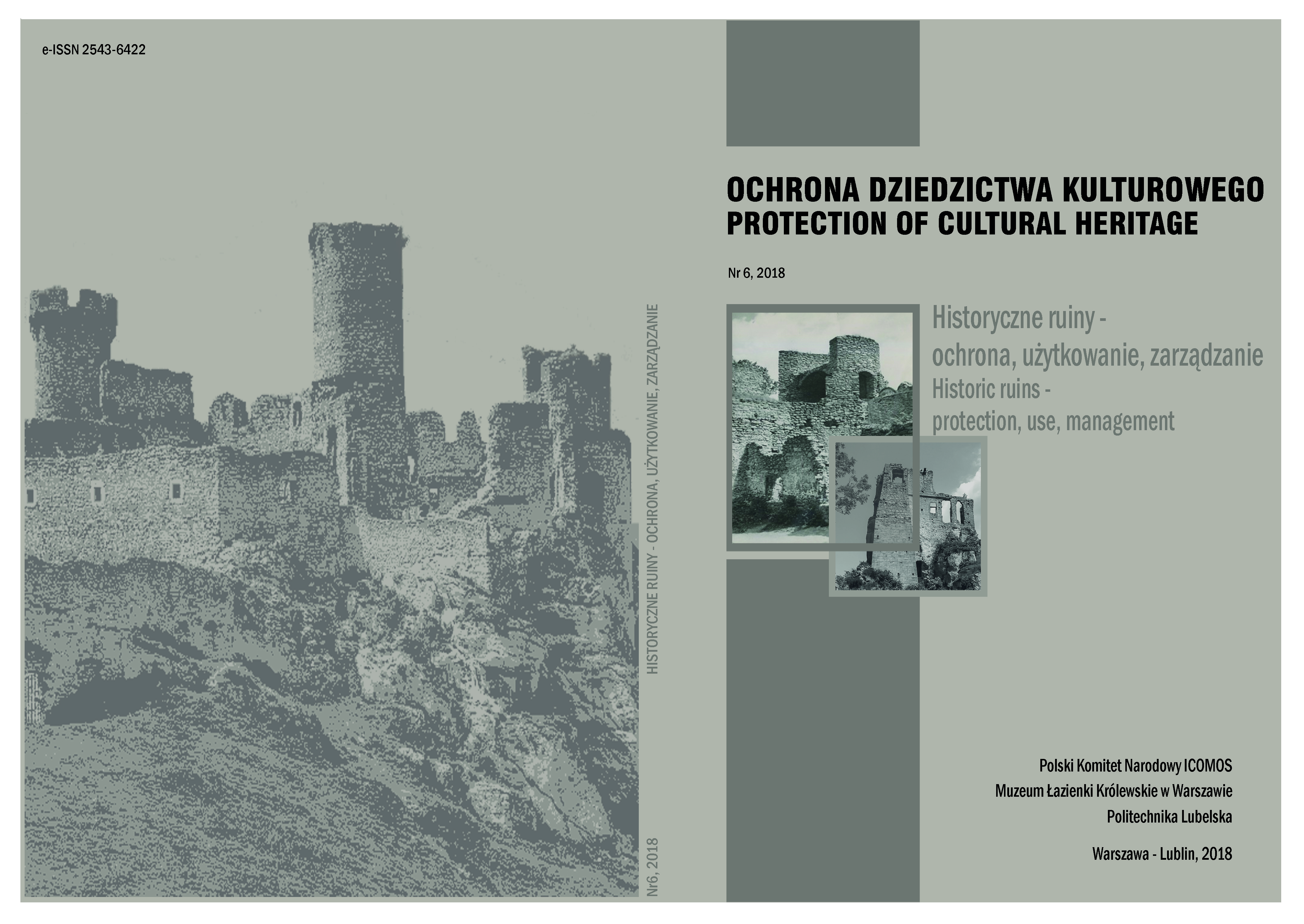
Open full text
Issue No. 6 (2018)
-
Protection of historical ruins - research and project problems on the example of the castle in Sochaczew
Maria Brykowska11-27
-
Protecting and displaying walls of the Człuchów Castle - former practices and current issues
Grzegorz Bukal29-42
-
Ambiguous role of post-industrial ruins in the cultural landscape of Poland
Jacek Dąbrowski, Bartosz M. Walczak43-52
-
The attractiveness of a permanent (durabel) ruin. Contemporary functioning of the historical ruins of castles in Małopolska
Paweł Dettloff53-71
-
Stocktaking methods of facilities in a state of ruin
Katarzyna Drobek, Bartosz Szostak, Wojciech Królikowski73-86
-
Charter on the Protection of Historic Ruins – theory and practice. Examples from Lesser Poland
Jan Janczykowski87-95
-
Urban design concepts of ruins in Gdańsk historical area
Agnieszka Kowalska97-104
-
Protection of historical ruins on the Polish-German border. A case of cultural heritage of the former Duchy of Pomeranian
Izabela Kozłowska, Agnieszka Lamprecht105-116
-
Protection and preservation of ruins - changes in the methods used in the Mazovian region
Jakub Lewicki117-134
-
'Foundation of Memory'. About the experience of space and remnants of the former concentration camp at the Kl Plaszow memorial site
Tomasz Owoc, Kamil Karski135-143
-
Some forts of Cracow Fortress become historical ruins. Purpose or necessity
Halina Rojkowska-Tasak145-151
-
Castle in Siewierz. Preservation and revalorisation of the historic ruins
Artur Rok153-162
-
Hammershus Castle - "Good Practices" and Managing Permanentl Ruin
Andrzej Siwek, Magdalena Trafas-Wołoszyn163-176
-
Selected issues of the investment process implementation in historic buildings on the example of the Castle of the Dukes of Mazovia in Ciechanów
Antoni Krzysztof Sobczak177-190
-
Protection of historic ruins - objectives for theory and practice
Bogusław Szmygin191-200
-
Biological corrosion and vegetation in the aspect of permanent ruin
Maciej Trochonowicz, Beata Klimek, Daniel Lisiecki201-212
-
Salt mill complex and warehouses of the former salt mine in Wapno. Considerations and premises for the protection of 20th-century post-industrial buildings as a permanent ruin
Miron Urbaniak213-223
Main Article Content
DOI
Authors
Abstract
The article presents the mechanisms of biodegradation of structures in permanent ruins. There are also principles of proceeding in removing undesirable vegetation in these objects. Particular attention was paid to issues related to the diversity of damage caused by biological organisms. Rules for the removal of lichens, algae and fungi algae as well as the procedures for removing unwanted higher plants are presented.
Keywords:
References
Building Research Establishment. Control of lichens, moulds and similar growths. Garston, Watford: Building Research Establishment, 1992.
Donnelly J., Ruins: the Conservation and Repair of Masonry Ruins, Government Publications Sales Office, Dublin, 2010.
Eklund J. A., Young M. E., Biological Growth on Masonry: Identification &Understanding. Inform. Information of historic building owners, Historic Scotland, 2013.
Fawcett R., Treatment of vegetation at monuments [w:] The Conservation of Architectural Ancient Monuments in Scotland. Guidance on Principles, Historic Scotland. Longmore House. Salisbury Place. Edynburg 2001.
Ferraby S., The ecology of ruin sites [w:] Conservation of Ruins, J. Ashurst (red.), Elsevier Science & Technology, 2006.
Further Reading and Contacts Biological Growths on Sandstone Buildings: Control & Treatment, Technical, Advice & Guidance, Technical Advice Notes, Historic Scotland, t. 10, 1997.
Gordon R., Biological Growths, Biocide Treatment, Soiling and Decay of Sandstone Buildings and Monuments in Scotland. Report on research commissioned. Historic Scotland and The Robert Gordon University, 1995.
Jasieńko J., Mierzejewska O., Hamrol K., Misztal W., Utrwalanie koron murów obiektów historycznych przeznaczonych do ekspozycji w formie trwałej ruiny, Wiadomości konserwatorskie nr 30, 2011.
Kozarski P., Molski P., Zagospodarowanie i konserwacja zabytkowych budowli. Towarzystwo Przyjaciół Fortyfikacji, Fortyfikacje t. XIV, Warszawa 2001.
Quinlan M., Hanna M., Kelly D., The conservation and repair of masonry ruins, Government of Ireland, Dublin, 2010.
Sieniawska–Kuras A, Potocki P., Przyczyny zniszczeń obiektów budowlanych i elementów architektonicznych. Procesy biologiczne. [w:] Renowacja elementów architektury. Wydawnictwo i handel książkami „KaBe”, Krosno 2012.
Strzelczyk A. B., Czynniki niszczące kamienie. Czynniki biologiczne, [w:] Zabytki kamienne i metalowe ich niszczenie i konserwacja profilaktyczna, W. Domasłowski (red.), Wydawnictwo Naukowe UMK, Toruń 2011.
Tajchman J., Metoda zabezpieczania i rewitalizacji ruin historycznych jako szczególny rodzaj konserwacji i restauracji zabytków architektury, Materiały z międzynarodowej konferencji naukowej, Gubin 2008.
Trochonowicz M., Zamek w Janowcu nad Wisłą. Ocena stanu wilgotnościowego i zasolenia murów. Politechnika Lubelska, Lublin 2006.
Ważny J., Karyś J. (red.), Ochrona budynków przed korozją biologiczną Arkady, Warszawa 2001.
Young M., Wakefield R., Research commission investigating biological growths, biocide treatment soiling and decay of sandstone buildings and monuments in Scotland. 1995.
Article Details
Abstract views: 466
Maciej Trochonowicz, Faculty of Civil Engineering and Architecture, Lublin University of Technology
dr inż., absolwent Wydziału Budownictwa i Architektury Politechniki Lubelskiej, asystent w Katedrze Konserwacji Zabytków Politechniki Lubelskiej, prowadzi prace badawcze dotyczące izolacji wykonywanych metodami chemicznymi – tematyka rozprawy doktorskiej, specjalizuje się w zagadnieniach związanych z oceną stanu technicznego obiektów pod kątem zawilgocenia, zasolenia i rozwoju korozji biologicznej, autor i współautor ponad 70 artykułów naukowych i popularnonaukowych oraz blisko 220 różnego typu opracowań technicznych.
Beata Klimek, Faculty of Civil Engineering and Architecture, Lublin University of Technology
doktor, pracuje na stanowisku asystenta w Katedrze Konserwacji Zabytków na Wydziale Budownictwa i Architektury Politechniki Lubelskiej. Zajmuje się analizą i identyfikacją materiałów historycznych przede wszystkim w zaprawach sztukatorskich i tynkarskich. Autorka i współautorka opracowań, artykułów oraz ekspertyz z zakresu badań technicznych obiektów.
Daniel Lisiecki, Faculty of Civil Engineering and Architecture, Lublin University of Technology
mgr inż., absolwent Wydziału Budownictwa i Architektury Politechniki Lubelskiej, Specjalista do spraw badań i analiz w zakresie ochrony historycznych ruin. Współautor publikacji naukowych oraz licznych opracowań technicznych.



