

Ratio legis est anima legis and the need to exist and strengthen the state conservation service in Poland
Article Sidebar
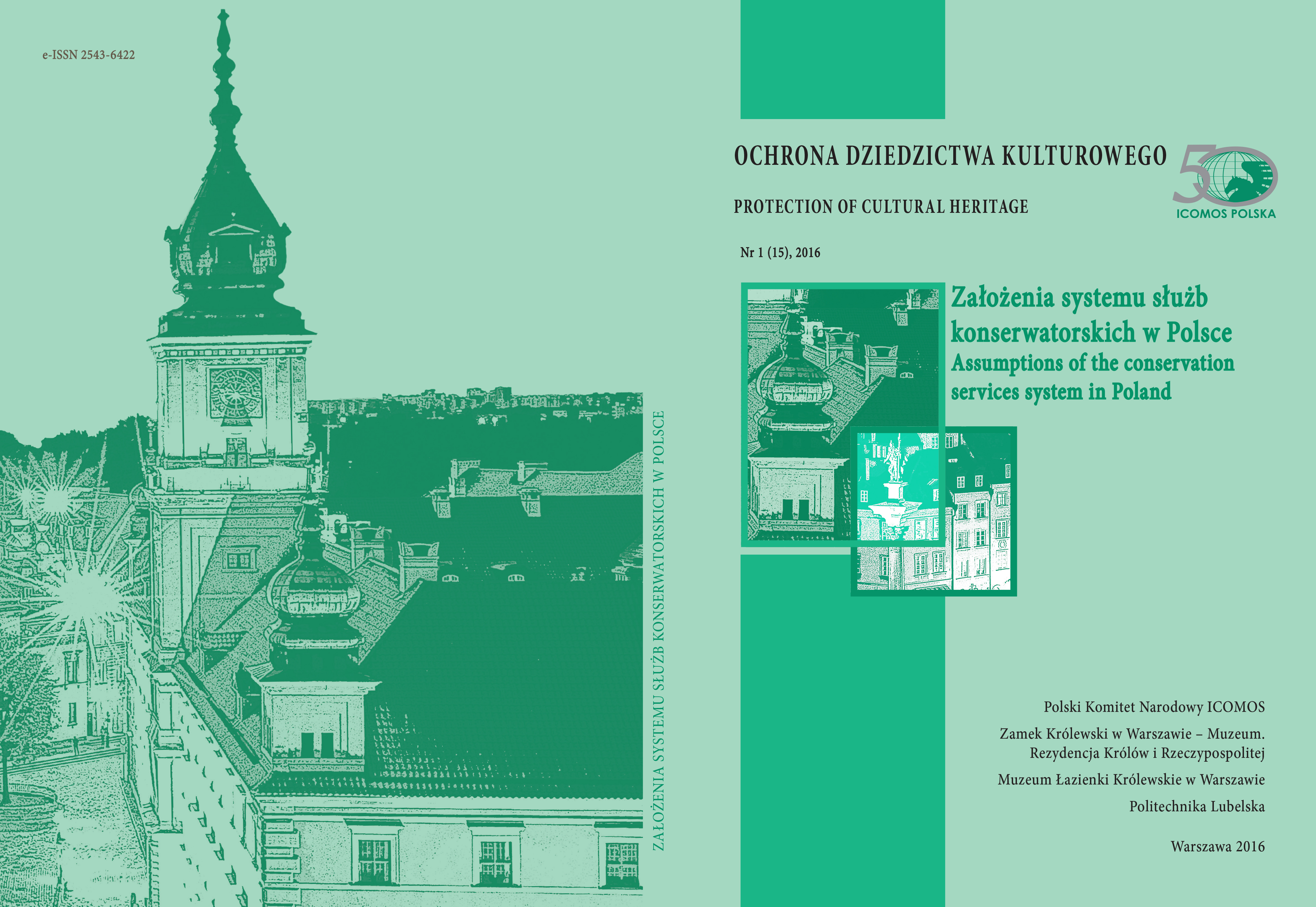
Open full text
Issue No. 1 (2016)
-
Proposals of assumptions for the system of conservation services - the position of voivodeship conservators
Barbara Bielinis-Kopeć7-13
-
Actions of the Roman Catholic Church in Poland in the field of monument protection
Zbigniew Czernik15-30
-
Monuments protection services in Poland - legal location from 1918 to today, the prospect of changes from 2017
Jacek Dąbrowski31-40
-
Ratio legis est anima legis and the need to exist and strengthen the state conservation service in Poland
Piotr Dobosz41-49
-
The system of monument protection services in Poland and social participation in the protection of monuments
Stefan Fuglewicz51-60
-
What is the system of monument protection? Unanswered questions ...
Marcin Gawlicki61-69
-
The importance of local governments in the protection of monuments. Suggestions for changes
Małgorzata Gwiazdowska71-76
-
Conservation Office and monument, that is, the influence of the office on the preparation and implementation of conservation works
Małgorzata Korpała77-84
-
Together or separately, i.e. the need for integrated protection of cultural and natural heritage in the activities of conservation offices
Jakub Lewicki85-92
-
Organizational meanders of conservation services in Poland after 1918
Antoni Oleksicki93-106
-
Programs for the protection and care of monuments - an underestimated element of the Polish system of monument protection
Andrzej Siwek107-115
-
Wawel in the Polish system of conservation services
Piotr M. Stępień117-119
-
Conditions and assumptions of the system of monument protection services in Poland
Bogusław Szmygin121-128
-
The role of the “Records card of immovable propertis” in the protection and conservation of architectural heritage 2nd half of the 20th century
Małgorzata Włodarczyk129-133
-
Conservation Theses 2015 - a proposal for the reform of monument protection services
Aleksander Broda, Marek Konopka, Halina Landecka, Katarzyna Zalasińska, Tadeusz Zielniewicz135-140
Main Article Content
DOI
Authors
Abstract
This article focuses on the Latin legal maxim read as „ratio legis est anima legis.” It needs to be emphasised that, unless they are well-considered, no approval will be granted to acts which are invalid from legal and formal perspective or under which legally incorrect substantive solutions are to come into force.
The author of this article claims that Polish central government may prove useful in the field of protecting historic monuments and sites. Furthermore, the article also explores experiences through which the German government went in the areas pertaining to constitutional law and organisation of German (federal and lance) historic preservation administration.
In the conclusion, the author summarizes his deliberations on the Polish model of administrative bodies responsible for conservation and protection of historic monuments and sites.
Keywords:
References
Deutscher Bundestag. Ustawa Zasadnicza dla Republiki Federalnej Niemiec Tekst bez komentarza Stan: październik 2010 r., Przekład: A.-M. Sadowski, Korekta merytoryczna: A. Malicka, Berlin 2010.
Dobosz P., Systemy prawne ochrony zabytków z perspektywy teorii prawa administracyjnego/tytuł równoległy: Legal systems governing the protection of monuments in view of the theory of administrative law, Kraków 2015, https://issuu.com/michaadamus/docs/systemy_prawne_-_p._dobosz.
Faber H., Verwaltungsrecht, Tübingen 1987.
Geschäftsordnung der Ständigen Konferenz der Kultusminister der Länder in der Bundesrepublik Deutschland gemäß Beschluss vom 19. November 1955 i. d. F. vom 29. August 2014, http://www.kmk.org/fileadmin/pdf/gogr.pdf, (dostęp: 22.08.2015).
Grundgesetz für die Bundesrepublik Deutschland (GG), 23 maja 1949 (BGBl. S.1), ost. zm.: BGBl. I.
Jagłowski P. M., Niemcy: System ochrony zabytków archeologicznych, [w:] Ochrona dziedzictwa archeologicznego w Europie, red. Z. Kobyliński, Warszawa 1998.
Jagłowski P. M., System ochrony zabytków archeologicznych, [w:] Ochrona dziedzictwa archeologicznego w Europie, red. Z. Kobyliński, Warszawa 1998.
Kamiński M., Zarys koncepcji dobra prawnego objętego ochroną norm prawa administracyjnego (dobra administracyjnoprawnego), [w:] Dobra chronione w prawie administra¬cyjnym, red. Z. Duniewska, Łódź 2014.
Kijowski R., Rzeczy i urządzenia publiczne, [w:] Z. Duniewska, M. Górski, J. Jagielski, J. Kierzkowska, D. Kijowski, H. Nowicki, J. Stelmasiak, M. Szalewska, M. Zdyb (redaktorzy: R. Hauser, Z. Niewiadomski, A. Wróbel), System prawa administracyjnego. T. 7. Prawo administracyjne materialne, Warszawa 2012.
Konstytucja Rzeczypospolitej Polskiej z dnia 2 kwietnia 1997 r. uchwalona przez Zgromadzenie Narodowe w dniu 2 kwietnia 1997 r., przyjęta przez Naród w referendum konstytucyjnym w dniu 25 maja 1997 r., podpisana przez Prezydenta Rzeczypospolitej Polskiej w dniu 16 lipca 1997 r., Dz. U. z 1997 r. nr 78, poz. 483 ze zm.
Konstytucji Badenii-Wirtembergii z dnia 11 lipca 1953 r. – Verfassung des Landes Baden-Württemberg vom 11. November 1953 (GBl. S. 173) z póź. zm. i uzup.
Laux E., Vom Verwalten: Beiträge zur Staatsorganisation und zum Kommunalwesen, Freiherr-vom-Stein- Gesellschaft e. V, H.Siedentopf, K. Treppe (Hrsg), Baden-Baden 1993.
Projekt Konkluzjach Rady Europejskiej z dnia 21 maja 2014 r. na stronie: http://register.consilium.europa.eu/doc/srv?l=PL&f=ST%209129%202014%20INIT, (dostęp: 28.9.2015).
Pruszyński J. P., Ochrona prawna zabytków w Republice Federalnej Niemiec. Teksty i komentarze, Warszawa 1992.
Pruszyński J., Dziedzictwo kultury Polski. Jego straty i ochrona prawna, t. I, Kraków 2001.
Rouba M., Zadania władz publicznych w zakresie ochrony i opieki nad zabytkami w Rzeczypospolitej Polskiej ze szczególnym uwzględnieniem obiektów wpisanych na Listę Światowego Dziedzictwa Kulturalnego i Naturalnego UNESCO, Toruń 2013.
Schmidt-Aβmann E., Ogólne prawo administracyjne jako idea porządku. Założenia i zadania tworzenia syste¬mu prawnoadministracyjnego. Wydanie drugie przeredagowane i rozszerzone w tłumaczeniu prof. Andrzeja Wasilewskiego, Warszawa 2011.
Szmygin B., System ochrony zabytków w Polsce – próba diagnozy, [w:] System ochrony zabytków w Polsce: analiza, diagnoza, propozycje, red. B. Szmygin, Lublin – Warszawa 2011, http://bc.pollub.pl/dlibra/doccontent?id=691.
Verfassung des Freistaates Bayern vom 2. Dezember 1946, obwieszczenie nowego brzmienia Konstytucji Wolnego Państwa Bawaria z dnia 15 grudnia 1998 r. (GVBl. Seite 991), zm. GVBl.
Zimmermann J., Prawo administracyjne, Warszawa 2014.
Article Details
Abstract views: 1093
Piotr Dobosz, Department of Administrative Law, Jagiellonian University
autor publikacji m.in. z zakresu ochrony i opieki nad dziedzictwem kulturowym, wieloletni pracownik konserwatorskiej administracji rządowej, członek kolegialnych organów centralnych do spraw ochrony zabytków oraz organizacji społecznych, prodziekan Wydziału Prawa i Administracji UJ na lata 2016–2020.



